
Airport Luggage Trolley Fleet Handover: A Practical Checklist for Terminal Operations
An airport luggage trolley fleet handover should do more than confirm that units have arrived. It should give operations, facilities, passenger-services, cleaning, procurement, and marketing teams a shared record of what was supplied, where it can be used, how it should be handled, and which questions remain open. A disciplined handover helps a terminal move from purchase or refurbishment into daily service without confusing model versions, losing maintenance information, or placing trolleys in unsuitable collection and storage points. This guide sets out a practical process for airports planning a new trolley fleet, a replacement batch, or a phased deployment.
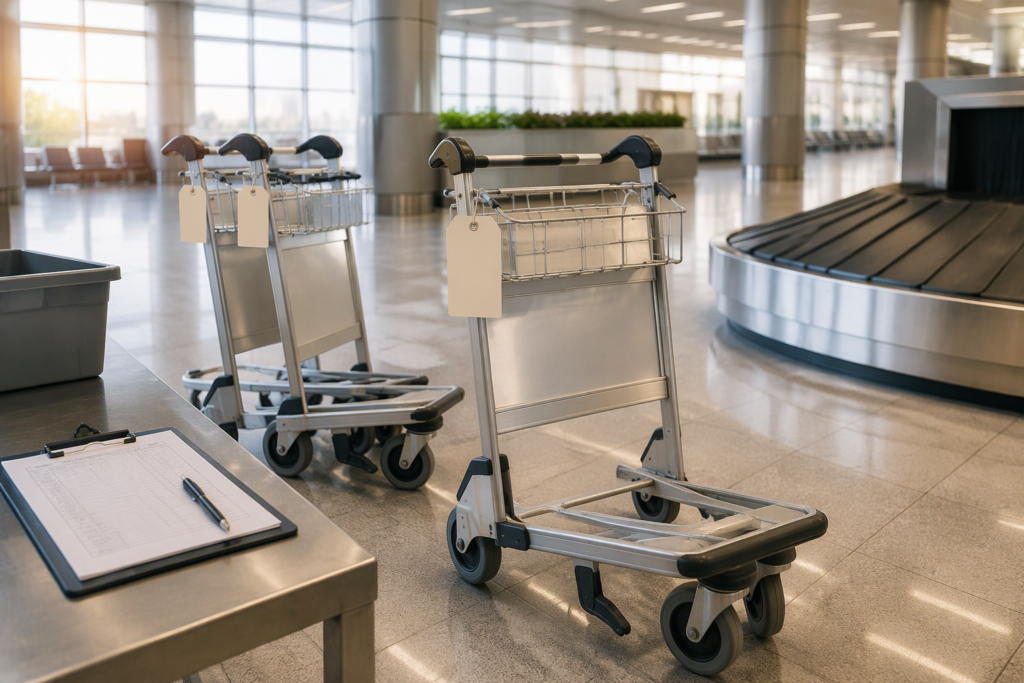
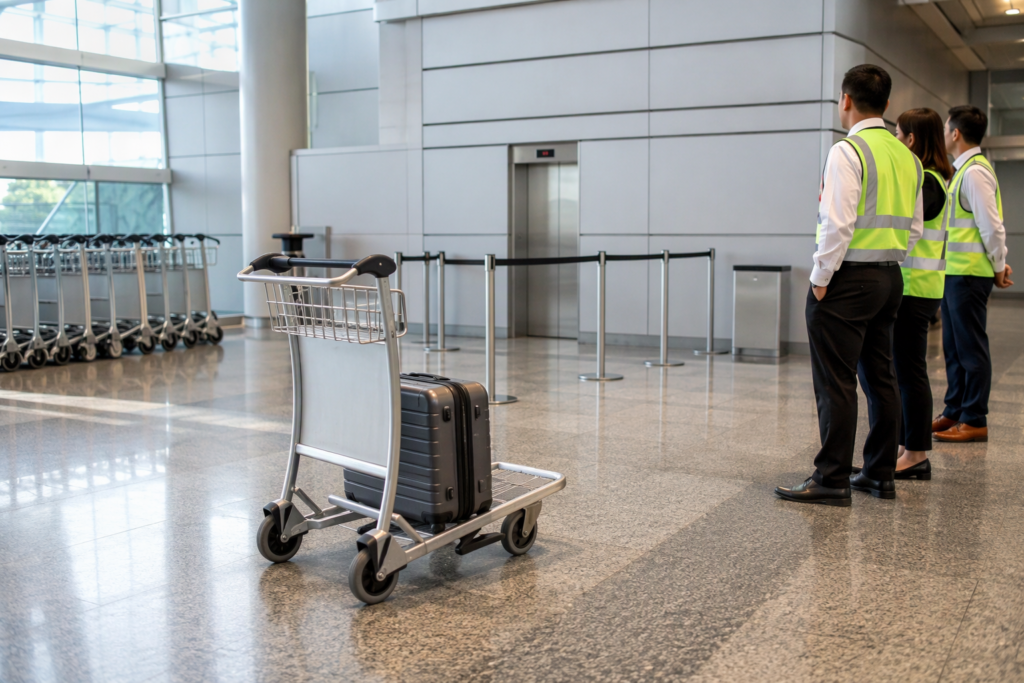
What a complete airport luggage trolley handover should confirm
The handover record should identify the exact product configuration rather than relying on a broad category name. MINGLE airport trolley lists BG Series, LG Series, and Shopper ranges, so the airport should record the selected family, model code, quantity received, and any approved variation. A fleet register can also include an internal asset number, delivery batch, intended zone, inspection status, and the person responsible for acceptance.
Product pages provide useful starting points for this record. For example, the CY-X4200-LG5 page describes a three-wheel aluminum airport luggage trolley, a 6063 high-strength aluminum alloy frame, a 525 × 354 mm advertising board, 180 mm natural rubber wheels, and a basket described as powder-coated steel or stainless steel. The CY-X4200-BG3 page describes a four-wheel stainless steel trolley, a 304 stainless steel structure, 180 mm natural rubber wheels, and several advertising-panel dimensions. These are model-specific published details, not assumptions that should be transferred to every trolley in a fleet.
Before signing the acceptance record, compare the delivered units with the quotation, drawing, approved sample, and current product information. If the documents use different names, pause the handover and request written clarification. Do not infer that two similar-looking units share the same brake, wheel, basket, handle, or nesting configuration.
Build the handover around terminal zones
A trolley can be correctly delivered and still be poorly deployed. The handover should therefore include a zone plan showing where passengers collect, load, push, pause, return, and leave each trolley. At minimum, review baggage reclaim, check-in, transfer routes, terminal entrances, car-park connections, lifts, and staff collection points where those areas are part of the airport’s operating plan.
For each zone, record the approved collection point, return or recovery route, storage position, responsible team, and any local restrictions. Note nearby queue barriers, doors, columns, seating, retail displays, moving walkways, and cleaning areas. A parked line may fit on a drawing but create a conflict when passengers are turning, waiting, or carrying oversized luggage. The handover is the right moment to record those observations and assign a corrective action rather than treating the issue as a product defect.
Use the existing airport trolley accessibility design guide as a related planning reference for clear routes, turning areas, wheel behavior, and stopping points. It does not replace the airport’s own access assessment or site trial. The practical handover question is whether the selected trolley and its parking method work in the route that passengers actually use.
A zone-by-zone acceptance check
- Baggage reclaim: Confirm that the collection point is visible, reachable, and separated from passenger discharge movements.
- Check-in: Confirm that nested or parked units do not narrow queues or obstruct counters and self-service equipment.
- Transfer: Observe turning, stopping, and recovery points near doors, lifts, and corridor junctions.
- Entrance and car park: Check thresholds, weather exposure, surface changes, and the route back to the terminal.
- Return and storage: Define where unsuitable units go and who prevents them from returning to the ready line.
Verify movement, loading, and storage behavior
A handover trial should use the surface and route where the trolley will operate, not only a warehouse floor. Test an empty unit first, then use a representative luggage arrangement approved by the airport team. Observe steering, turning, stopping, loading access, unloading access, nesting or folding interaction, and the effort required to move the unit into its planned storage position. Record the route and conditions so that an observation is not mistaken for a universal product claim.
The trial should also check physical contact points. Inspect the handle, frame, basket or loading platform, front protection, wheel assemblies, fasteners, and any advertising-panel area for visible damage or loose parts. If a model includes a brake or another stopping feature, use the supplier’s current instructions and the airport’s approved procedure. A visual check alone does not prove that a brake is operating correctly.
Storage is part of operational readiness. Measure the actual parked arrangement and record whether units are nested, folded, lined up, or moved in another approved way. Confirm that the recovery team can remove one unsuitable trolley without disturbing an entire group. If the fleet contains more than one model, keep the storage and identification method clear enough to prevent accidental mixing of units with different instructions.
Transfer maintenance and spare-part information
The supplier handover pack should include the information needed to keep the fleet identifiable and manageable. Ask for the current model reference, visible component list, cleaning restrictions, wheel and brake guidance where applicable, replacement-part references, and the process for removing a damaged unit from service. If a document is not provided, write it as an open action rather than filling the gap with a generic instruction from another trolley.
The airport can connect this information to a simple inspection record. Useful fields include date, location, model code, asset number, inspector, condition, action, and release status. Controlled dispositions such as ready, clean and return, monitor, repair, and remove from service make later review easier. Do not add unsupported service intervals, product life, failure rates, load limits, or repair promises. Those figures require model-specific documentation or the airport’s own approved records.
For a broader ownership view, link the handover to the airport trolley total cost of ownership guide. The relevant lesson is to keep quoted items, site measurements, local estimates, and unresolved supplier questions separate. This prevents a handover document from becoming an unverified warranty or performance statement.
Close the branding and communication handover
If the trolley includes an advertising board, sponsor panel, airport message, or other approved visual treatment, record the artwork version and the surface to which it applies. The handover should state who approved the artwork, whether the message is permanent or campaign-based, how replacement is requested, and how expired material is removed. It should also confirm that the treatment does not interfere with the handle, loading area, nesting interface, inspection label, or passenger visibility.
Use the airport trolley advertising panel branding guide to structure this discussion. That guide focuses on message hierarchy, installation, replacement, and passenger-friendly use; it should not be read as proof of a particular panel specification for every model. The exact panel dimensions and attachment method must remain tied to the selected trolley and approved artwork.
The same record should identify whether the panel is part of the supplied configuration or a later approved addition. Note the artwork file name, revision, orientation, and approval owner, then keep a copy with the fleet documentation. If a panel becomes scratched, loose, unreadable, or incompatible with cleaning, staff need a clear route for reporting it. Do not describe an advertising surface as a safety feature, and do not promise campaign visibility without a defined viewing test. These simple controls keep brand communication separate from unverified product performance claims.
Sign off staff readiness and unresolved actions
A fleet is not ready for normal service until the people responsible for it know what to do. The final handover meeting should include the teams that inspect, clean, recover, store, deploy, and report the trolleys. Demonstrate the approved route, collection point, storage method, defect-isolation process, and escalation contact. Keep the briefing practical and model-specific.
Use a short sign-off checklist:
- The model code and delivered configuration match the approved documents.
- Quantity, asset identifiers, and intended zones are recorded.
- Movement and parking trials are documented for representative routes.
- Defect, quarantine, recovery, and release responsibilities are assigned.
- Cleaning, wheel, brake, and replacement-part information is available or listed as an open action.
- Branding artwork, panel treatment, and replacement ownership are recorded where relevant.
- Staff briefing attendance and follow-up date are documented.
- Unresolved issues have an owner and a target review point.
Do not sign a “fully complete” handover when essential questions remain unanswered. Use statuses such as accepted, accepted with actions, or hold for clarification, according to the airport’s own governance process. This keeps the record useful without making unsupported claims about safety, compliance, durability, or performance.
Plan the next review before the fleet enters service
The handover is the beginning of controlled operation, not the end of procurement. Schedule a follow-up review after the airport team has observed the collection points, routes, storage positions, and inspection process in normal use. Compare the handover actions with actual reports, but do not turn a small number of observations into a general performance claim. A clear register, a zone-based deployment plan, model-specific documentation, and an accountable follow-up process give airport teams a practical foundation for managing luggage trolleys with fewer avoidable surprises.
At that review, separate product observations from process observations. A trolley that is difficult to recover may be affected by a storage location, a queue change, a surface transition, or unclear staff ownership rather than by the model alone. Record the evidence, assign the next action, and ask MINGLE for model-specific clarification when the product documentation does not answer the question. This keeps the improvement cycle grounded in the actual terminal rather than in assumptions copied from another fleet.
Need help preparing an airport luggage trolley specification or handover checklist? Contact us with the selected model family, terminal zones, operating routes, storage plan, branding requirements, and questions that must be confirmed before approval.