
Airport Trolley Advertising Panel Branding: A Procurement Guide
An airport trolley advertising panel should turn routine baggage movement into useful, readable brand communication without making the trolley harder to push, load, park, or maintain. Procurement teams should decide the panel’s job first—wayfinding support, airport service information, partner branding, or a short campaign message—then set rules for readability, hierarchy, installation, replacement, and passenger clearance. MINGLE airport trolleys includes BG, LG, and Shopper lines, while its site also describes custom branding options, ergonomic push handles, reinforced frames, industrial-grade wheels and casters, and OEM/ODM support. This guide explains how to brief a panel so branding remains practical in a busy terminal.
Start with the Advertising Panel’s Job
A panel brief becomes clearer when the team identifies one primary communication purpose. A permanent airport message might direct passengers toward a service desk or reinforce the airport’s identity. A commercial panel may present a sponsor, retail partner, or service category. A seasonal panel may need faster replacement and a defined removal date. These purposes should not be mixed into one crowded design. If passengers must understand an instruction while walking, wayfinding should take priority over promotional copy. If the panel is primarily a brand surface, the logo and one short value statement may be enough.
Before requesting artwork, write a simple use case: who should notice the panel, where the trolley will operate, how long the message will remain, and what action—if any—the viewer should take. Consider both sides of a trolley if the unit can be approached from different directions, but do not assume both sides need identical content. A procurement team can ask the supplier whether the selected BG, LG, or Shopper airport trolleys supports the intended panel treatment and operating environment. The product family should remain suitable for the load, passenger flow, and cleaning routine; advertising is an added function, not a reason to compromise trolley performance.
A useful decision test is: “Would this message still be helpful if the passenger never scans a code or stops walking?” If the answer is no, simplify the panel and treat any QR code or URL as secondary. Airport environments contain distance, glare, noise, queues, and competing signs. A panel that communicates one idea quickly is more valuable than a miniature brochure attached to a trolley.
Build Readability into the Information Hierarchy
Readability starts with hierarchy, not decoration. Establish three levels: the main identifier, the supporting explanation, and an optional action. The main identifier could be a brand name, airport service, or short directional phrase. The supporting line should clarify the offer in plain language. The action might be a web address, QR code, or “Ask at the information desk,” but it should never overpower the first two levels. Keep the wording short enough to understand during ordinary trolley movement rather than designing for a stationary reader only.
Contrast should be checked against the real finish and lighting conditions, not just a monitor mock-up. Dark lettering on a light field or a light mark on a dark field is generally easier to scan than low-contrast brand colors. Avoid placing essential text across seams, mounting hardware, curved transitions, or areas likely to collect scuffs. Use a typeface with open letter forms and avoid long all-capital sentences. A designer should test the panel at the approximate viewing distance in a terminal-like environment, including overhead lighting and reflections.
Do not let a logo’s protection zone consume the entire useful panel. Reserve enough quiet space around the identity, then use alignment to make the remaining information feel intentional. If a QR code is proposed, test it after printing, mounting, cleaning, and normal handling. The code should be optional support; the key message must remain understandable without a phone. Procurement should request a proof showing front and rear views, text at final scale, color references, and any safety or operational labels that must remain visible.
Plan Installation and Handover Before Production
An advertising panel is a small interface between marketing, operations, the trolley supplier, the installer, and the cleaning team. Assign ownership for artwork approval, production approval, installation, acceptance inspection, and future replacement. A purchase order should identify the approved artwork version and explain whether the supplier supplies the panel, a printed insert, a protective overlay, or only a prepared mounting area. Ambiguity at this stage can create panels that look correct in a design file but cannot be installed without blocking handles, baskets, bumpers, or moving parts.
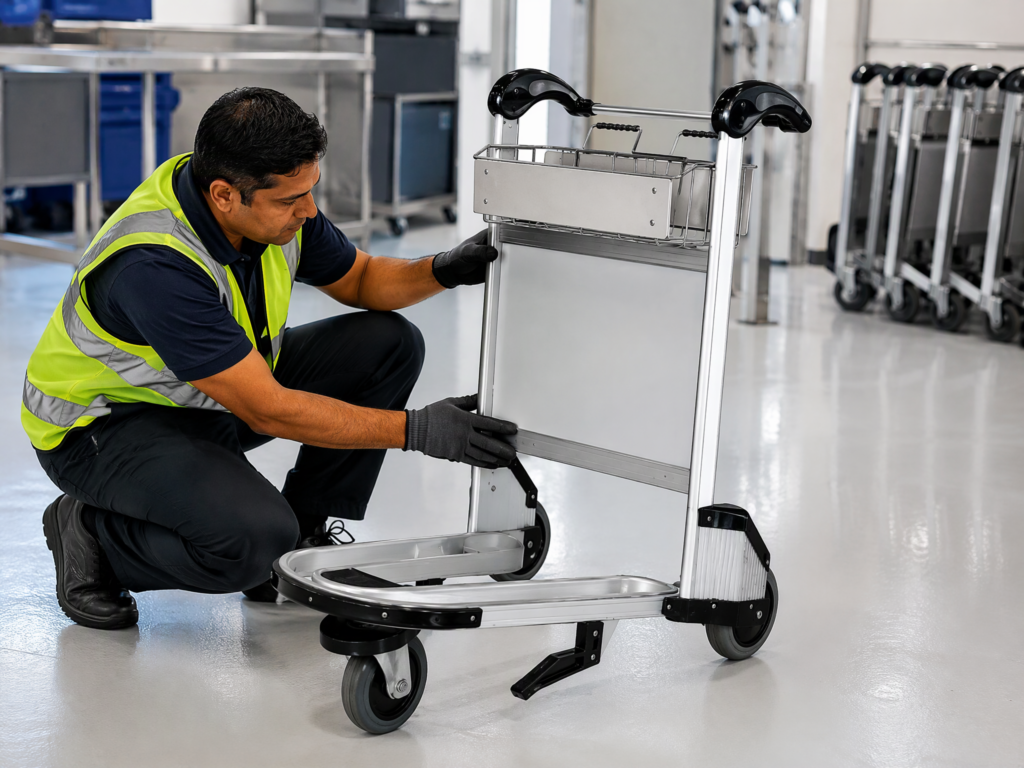
Request an installation drawing or marked-up product image that identifies the panel location, attachment method, edge treatment, and removal sequence. The drawing does not need invented dimensions in the marketing brief; it needs enough information for the operations team to understand what changes on the physical trolley. Confirm that fasteners, clips, adhesive, or rails do not create sharp edges, snag points, loose parts, or a surface that can catch luggage. The supplier’s product series page can be used as a starting point for discussing the selected model and its customization needs.
Handover should include a clean master artwork file, a print-ready file, color references, revision date, installation instructions, cleaning guidance, and a replacement contact. Keep a small acceptance sample or approved “golden unit” so later replacement panels can be compared with the intended finish. If the airport uses multiple trolley pools, record which pool receives which message. This protects brand consistency while allowing operations to retire, repair, or rotate units without guessing.
Keep the Panel Compatible with Passenger Handling
A successful advertising panel is visible but unobtrusive. It must not reduce a passenger’s ability to grip an ergonomic push handle, place baggage securely, see the load area, or maneuver the trolley. The panel should not protrude into a walking path or create a new pinch, snag, or impact concern. It should also avoid covering model labels, safety notices, trolley return instructions, or inspection markings that staff need to see.
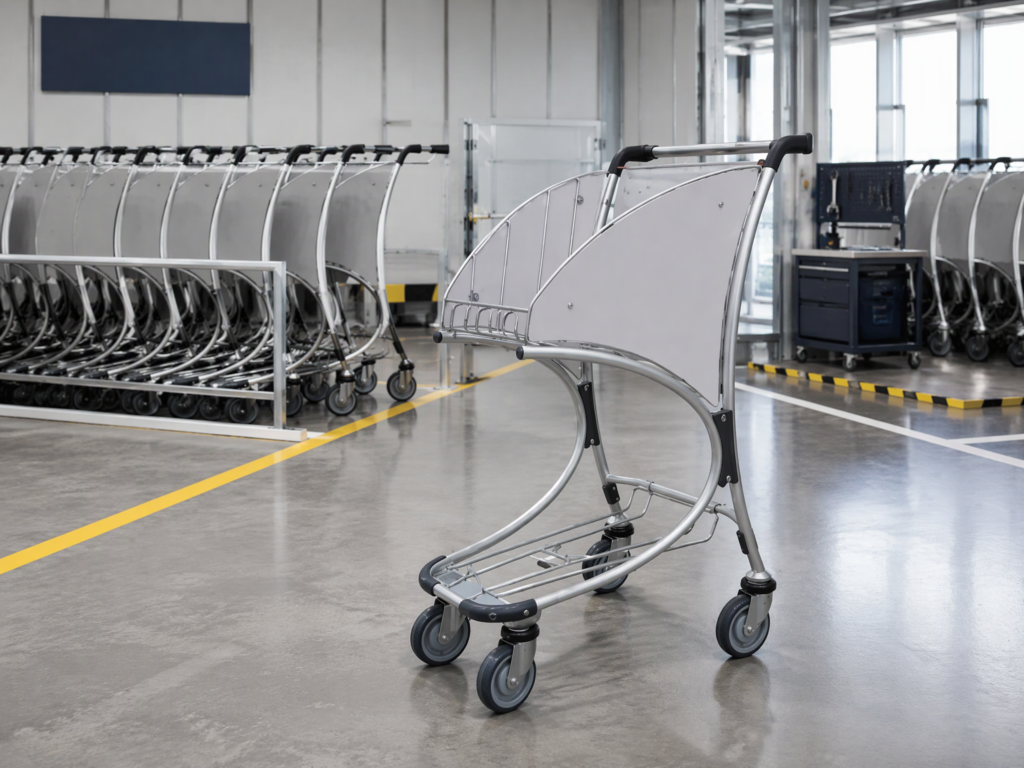
Review the design with an operations representative, not marketing alone. Ask staff to simulate common actions: approaching the trolley, grasping the handle, loading a suitcase, turning in a queue, nesting or parking units, and separating one trolley from a train. Check the panel when the trolley is empty and loaded. Also inspect stacked or nested trolleys if the design is installed on a fleet that nests, because a panel that works on one unit may rub against the next unit or make separation awkward.
Accessibility review should consider the whole route, not just the panel. The U.S. Access Board explains that accessible routes require continuous clear width and that greater clearance is needed for 180-degree turns and wheelchair turning space; it also describes passing spaces. See the ABA accessible routes guide for authoritative route guidance. The panel itself does not replace local accessibility review, but its location and any trolley parking plan should not reduce required circulation or turning space. Treat clearance as an operational acceptance check and confirm local requirements with the airport’s responsible team.
Design for Cleaning, Repairs, and Message Changes
Airport trolleys face frequent contact, dust, luggage abrasion, cleaning chemicals, and outdoor-to-indoor temperature changes. Specify a surface that can be cleaned with the airport’s approved process and avoid artwork that depends on delicate raised details in high-contact areas. Ask how the printed message will be protected, what happens if one corner lifts, and whether a damaged panel can be replaced without taking a trolley out of service for an extended period.
A maintenance plan should define inspection frequency, defect categories, and escalation. “Unreadable,” “peeling,” “sharp edge,” “loose attachment,” and “interferes with nesting” are more useful than a general instruction to inspect branding. Keep spare panels or approved replacement artwork only when the message is still authorized. For campaigns, add start and end dates to the asset register and identify who removes expired content. A panel that remains after a campaign can create a trust problem and may conflict with a current sponsor or airport communication.
Ask for a cleaning test on the actual panel finish before fleet rollout. Record whether the colors, laminate, edges, and attachment points remain stable after the agreed process. The same test can reveal glare, fingerprints, and residue that were not visible in a studio proof. MINGLE is the appropriate route for discussing product details, personalized solutions, and the handover information needed for a custom branding request.
Airport Trolley Advertising Panel Design Checklist
Use this checklist in the sourcing brief and final acceptance review:
| Checkpoint | Procurement question | Acceptance evidence |
|---|---|---|
| Purpose | Is the panel informational, directional, promotional, or seasonal? | One-sentence use case and owner |
| Hierarchy | Can a passenger grasp the main message quickly? | Full-scale proof and viewing test |
| Contrast | Does the design remain readable under terminal lighting and glare? | Printed sample or controlled light review |
| Hardware | Does installation avoid handles, load areas, moving parts, and sharp edges? | Marked-up drawing and physical inspection |
| Operations | Can staff push, load, nest, park, and separate the trolley normally? | Staff simulation on empty and loaded units |
| Route | Will trolley placement and panel protrusion preserve circulation? | Operations and accessibility review |
| Maintenance | Can the surface be cleaned and replaced using approved procedures? | Cleaning test, spare plan, and instructions |
| Governance | Who approves, installs, audits, removes, and archives each message? | Named owners and revision-controlled artwork |
The final sign-off should combine marketing approval with operations, safety, facilities, and accessibility input where applicable. A panel is ready when it communicates clearly and remains compatible with the trolley’s daily work, not merely when the artwork receives a brand approval.
Request a Branding-Ready Trolley Brief
A clear brief helps the supplier evaluate the trolley model, panel purpose, artwork, attachment approach, and operating constraints together. Send the use case, preferred series, locations, message duration, proof requirements, cleaning process, and handover expectations. For product details, pricing, or a personalized OEM/ODM discussion, contact MINGLE for an airport trolley inquiry. The goal is a branded trolley that passengers can understand at a glance and staff can keep in reliable service. Include the approved artwork version, expected replacement path, cleaning restrictions, acceptance owner, and any route or parking review required by the terminal. Ask the supplier to confirm what must remain visible for operations and how the selected branding treatment will be checked before wider rollout. This final exchange turns a creative concept into a practical procurement record that can be reused for future messages and trolley batches. It also gives marketing and terminal operations a shared reference when the design is refreshed, a panel is replaced, or a trolley moves between approved service areas.