
Airport Trolley Total Cost of Ownership: A Procurement Planning Guide
Airport trolley total cost of ownership is more useful than comparing a unit price alone. A procurement team should consider the trolley’s intended passenger zones, model configuration, delivery scope, inspection process, storage method, replacement parts, branding requirements, and eventual renewal decision. This does not mean inventing a lifetime cost or assuming a fixed service interval. It means building a transparent checklist so the airport can compare quotations on the same basis. This guide explains how to plan that comparison for baggage reclaim, check-in, transfer routes, and other passenger-facing areas using documented product information and site-specific questions.
What total cost of ownership means for airport trolleys
Total cost of ownership is a planning framework. It combines the costs and decisions that occur before purchase, during daily operation, and when a trolley is repaired, relocated, withdrawn, or replaced. For an airport trolley fleet, those stages can include specification work, samples, approval, procurement, receiving, inspection, storage, cleaning, handling, spare parts, staff time, branding changes, and end-of-service treatment. Some items may be priced by a supplier, while others must be estimated by the airport’s own operations and facilities teams.
The framework is especially useful when two quotations appear similar but describe different configurations. A trolley with a different basket arrangement, brake setup, wheel system, handle design, folding or nesting behavior, or advertising-panel treatment may create different requirements for testing and storage. MINGLE airport trolleylists BG, LG, and Shopper families and a range of model codes. That product range is a starting point for comparison, not a reason to assume every model has the same operating cost.
A responsible cost review keeps verified facts separate from local assumptions. The supplier can confirm the selected model, materials, visible features, available options, and quotation scope. The airport must assess its own routes, staffing, collection process, cleaning method, loss rate, storage capacity, and approval requirements. Label each item as quoted, measured, estimated, or still to be confirmed.
Separate the purchase price from the specification cost
The first cost layer is not only the trolley price. It is the work required to define what should be purchased. A clear brief may require operations, procurement, facilities, passenger-services, accessibility, safety, cleaning, and marketing input. If the airport skips this step, the apparent saving from a low unit price can disappear when the delivered configuration does not fit the intended route or storage point.
Start with a zone map. Identify where passengers collect, push, park, return, and separate trolleys. Baggage reclaim, check-in, transfer corridors, car-park connections, and staff collection points may place different demands on the same fleet. Next record the required decisions: trolley family, model code, basket or platform arrangement, wheel configuration, brake requirement, nesting or folding behavior, handle position, bumper protection, finish, and any approved branding treatment.
Use MINGLE’s BG Series page and LG Series page to organize the first comparison, then request model-specific documentation. The separate gdmingle.com airport trolley category is an additional product reference site and should be recorded as such; it is not an airport-trolley.com internal link. Ask the supplier to confirm whether the same model name represents the same current configuration across the two sites before using either page in a purchase specification.
Compare operation, storage, and handling requirements
Daily handling can become a significant part of the ownership picture. A trolley may be collected from a passenger area, moved to a return point, cleaned, inspected, nested or parked, and sent back into service. The time and equipment required for those steps depend on the airport’s layout and procedures. Do not convert a product feature into an unsupported labor saving. Instead, observe the current process and define what the new trolley must make possible.
For example, the airport can document whether staff need to move single units, trains of nested trolleys, or mixed model groups. Record the distance from collection points to storage, the width of the route, lift or door interactions, temporary parking locations, and any handover between airport staff and contractors. If a model folds or nests, measure the actual stored configuration and verify that the parked line does not reduce passenger circulation. If it does not fold or nest in the same way, add the required storage footprint and handling equipment to the comparison.
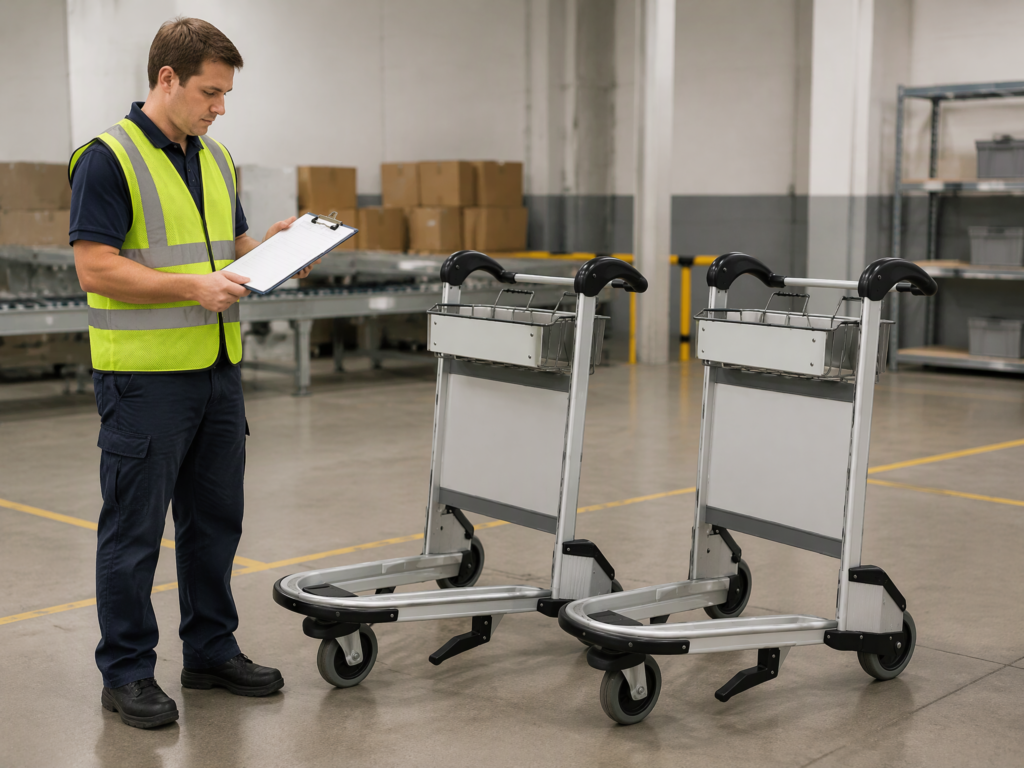
A practical trial should include an empty trolley and a representative operating load. Staff can record steering, stopping, separating, parking, and retrieval observations without turning them into a universal performance claim. The U.S. Access Board’s accessible-route guidance discusses continuous clear width, turning clearance, and passing spaces. Those requirements concern accessible route planning; they should not be presented as a certification of a trolley. They are a reminder to include route and parking consequences in the ownership review.
Include maintenance and replacement planning without inventing service life
Maintenance belongs in the ownership model, but a procurement document should not invent a fixed service interval, product lifespan, failure rate, or replacement cost. Those values must come from the supplier, a written airport procedure, or the airport’s own records. The useful starting point is a component-based inspection plan that can be adapted to the exact model.
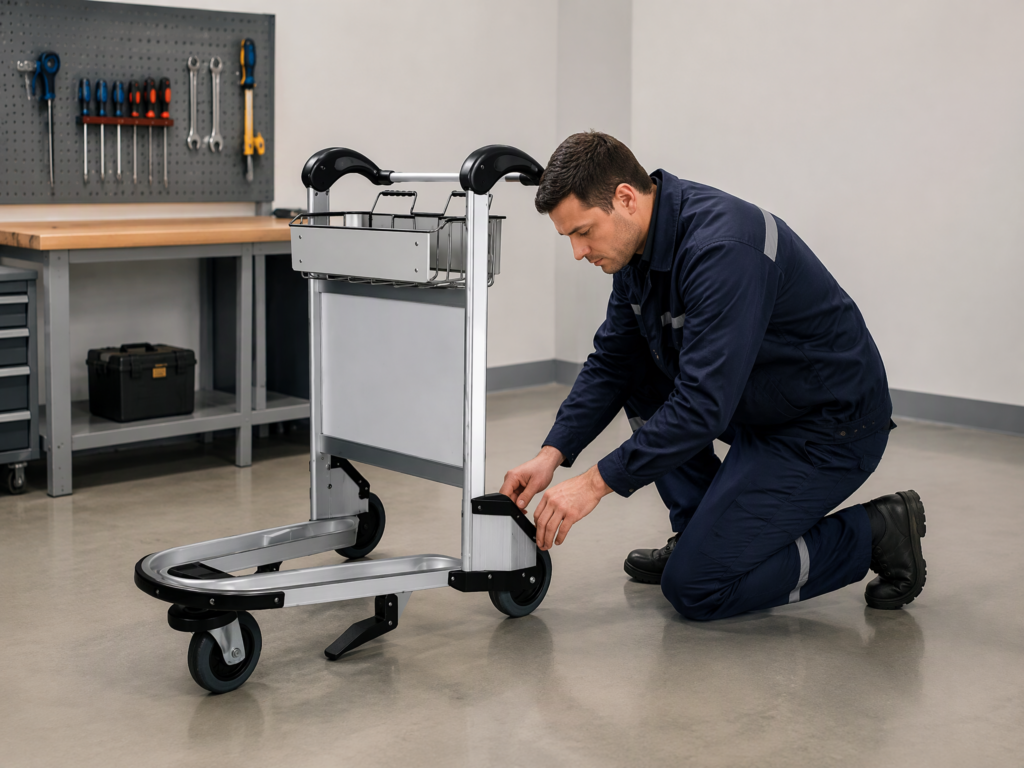
A basic record can cover the handle, frame, basket or loading platform, bumper, wheels, brake, nesting or folding interface, visible fasteners, and labels. Use clear dispositions such as ready, clean and return, monitor, repair, and remove from service. Record the model code and location so recurring findings can be connected to a specific zone or operating condition. If a trolley is repeatedly damaged near one doorway or queue barrier, the corrective action may involve layout or storage rather than a different frame material.
Before approval, ask MINGLE for the current model-specific maintenance information, replacement-part references, wheel and brake guidance, cleaning restrictions, and the process for removing a defective unit. The Shopper category can help separate that product family from BG and LG comparisons, but it does not replace a quotation for the selected configuration. Keep all unconfirmed values marked as questions rather than turning them into promises about durability or operating cost.
Account for branding, cleaning, and configuration changes
A fleet may carry an advertising panel, airport identity, service message, or another approved treatment. Branding adds decisions that can affect ownership cost: artwork preparation, proof approval, installation, cleaning compatibility, replacement stock, message rotation, and removal of expired content. It can also affect which model surfaces and mounting areas need review.
The branding should remain compatible with passenger handling. It should not interfere with the handle, loading area, nesting interface, safety information, inspection labels, or staff visibility. Request a marked-up drawing or model-specific image showing the intended panel position and attachment method. Test the final finish with the airport’s approved cleaning process before ordering a large batch. Record who owns the artwork and who approves future revisions.
Do not assume that a branded panel is a permanent asset. A campaign may end, a sponsor may change, or a trolley may move between approved service areas. Add a simple asset register with the model or fleet group, artwork version, approval date, removal date if relevant, and replacement contact. MINGLE Airport Trolley Supplier is the appropriate place to request product-specific customization information and a quotation. A clear brief makes it easier to distinguish a product option from a marketing requirement.
Use a transparent comparison table before selecting a supplier
A total-cost review becomes easier when every supplier answers the same questions. The table below can be copied into a sourcing brief and expanded with the airport’s own figures.
| Cost or decision area | Question to document | Evidence to request |
|---|---|---|
| Configuration | Which exact model and current version are quoted? | Model code, drawing, quotation |
| Initial supply | What is included in the unit and delivery scope? | Commercial quotation and inclusions |
| Trial and approval | What sample or inspection stage is needed? | Trial plan and acceptance record |
| Storage | How will units be parked, nested, folded, or moved? | Site measurement and operating method |
| Maintenance | Which components and procedures are documented? | Model-specific instructions |
| Spare parts | Which replacement parts are available and identifiable? | Part references and supplier response |
| Cleaning | Which approved cleaning process will be used? | Airport procedure and compatibility confirmation |
| Branding | Is a panel, print, insert, or mounting provision required? | Artwork proof and installation detail |
| Training | Which staff need operating or inspection guidance? | Handover checklist |
| Renewal | What evidence triggers repair, quarantine, or replacement? | Airport disposition rules |
The comparison should show which figures are confirmed and which are local planning assumptions. Avoid giving a single “lifetime cost” number when key inputs are missing. A range can be useful internally, but the assumptions behind it should be visible to the decision makers.
Build the procurement brief around decisions, not promises
A strong brief makes the next supplier conversation more efficient. Include the airport’s zones, route constraints, storage points, expected operating conditions, preferred product family, required features, branding needs, inspection responsibilities, and the evidence required for approval. If a project is still in design, label unmeasured widths, slopes, turning spaces, and storage quantities as provisional.
Ask for one written response that identifies the exact model code, current configuration, materials stated for that model, wheel and brake arrangement, nesting or folding behavior, spare-part information, maintenance guidance, and quotation inclusions. If an item cannot be confirmed from the current product page, keep it open for confirmation. This protects the airport from treating a general category description as a project-specific commitment.
The final decision should involve the people who will use and support the fleet. Procurement can compare commercial scope; operations can review passenger handling; facilities can review maintenance and storage; accessibility and safety teams can review routes and local requirements; marketing can approve branding. That shared review is often more valuable than trying to reduce the comparison to one headline price.
Request a model-specific airport trolley comparison
If you are planning a new fleet or replacing airport luggage trolleys, send MINGLE the terminal zones, route measurements, storage method, preferred product family, wheel and brake questions, branding requirements, inspection process, and the evidence your approval team needs. Use the Airport Trolley to review the available range and contact us for a model-specific quotation. Ask for a written response that separates confirmed configuration details from items requiring a sample trial or site decision. That approach gives procurement, operations, facilities, and marketing one practical record for comparing the full ownership picture without relying on unsupported claims about price, service life, capacity, or performance.
Before requesting the quotation, attach the comparison table, identify the person responsible for technical questions, and mark every provisional measurement. Ask the supplier to return the model code, drawing or product reference, options, maintenance documents, spare-part information, and commercial inclusions in the same response. If the airport needs branding, cleaning approval, or a staged sample review, list those requirements separately so they are not lost inside a general request. This makes the next review easier to audit and reduces the risk that a low headline price hides an unresolved operational decision.