
Airport Trolley Accessibility Design: Wheel Selection, Braking and Clear-Width Planning
Airport luggage trolleys should support passenger movement without making accessible routes harder to use. The practical answer is to plan the trolley, its wheels, its braking behavior, and its parking position together with the terminal route. A suitable trolley is not simply one that carries luggage; it should be manageable in the spaces where passengers actually push, turn, stop, and pass other people. Airport planners and procurement teams should therefore review clear width, turning areas, thresholds, slopes, stopping points, and storage before selecting a model.
This is a planning guide, not an accessibility certification for any product. The U.S. Access Board’s accessible-route guidance describes a continuous clear width of 36 inches, with a reduction to 32 inches at certain points such as doorways for a limited distance. It also discusses additional clearance for 180-degree turns and passing spaces. Those dimensions belong to accessible-route planning; they should not be treated as a claimed product performance result. The useful procurement lesson is simple: test the trolley in the route, not only in a product showroom.
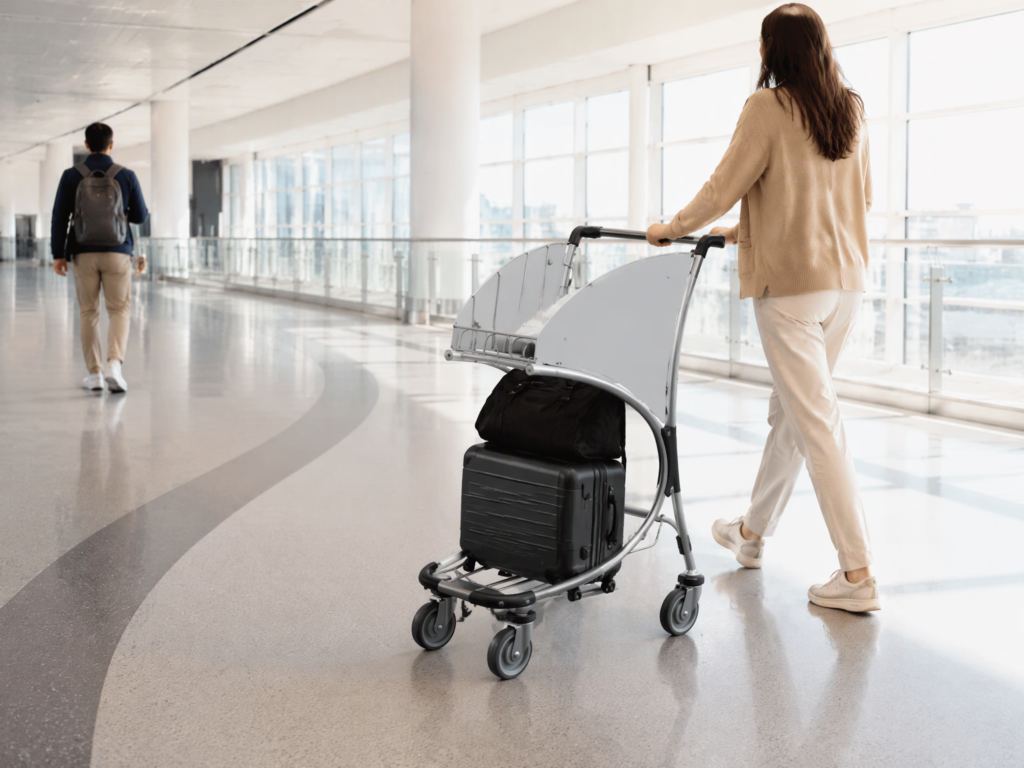
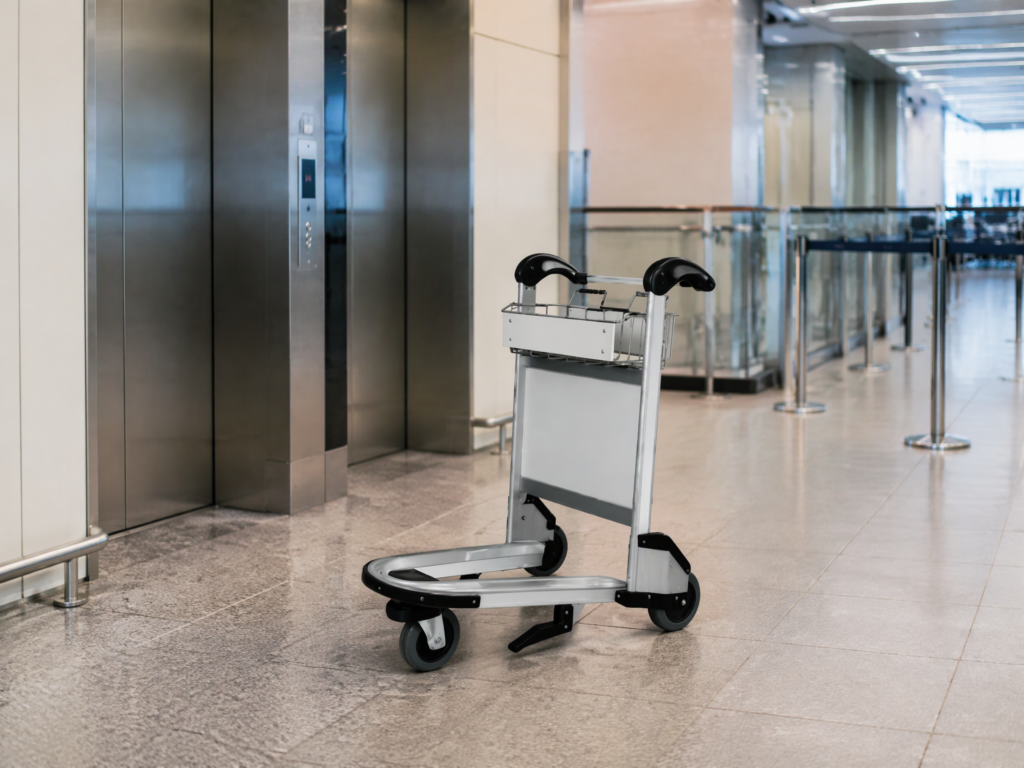
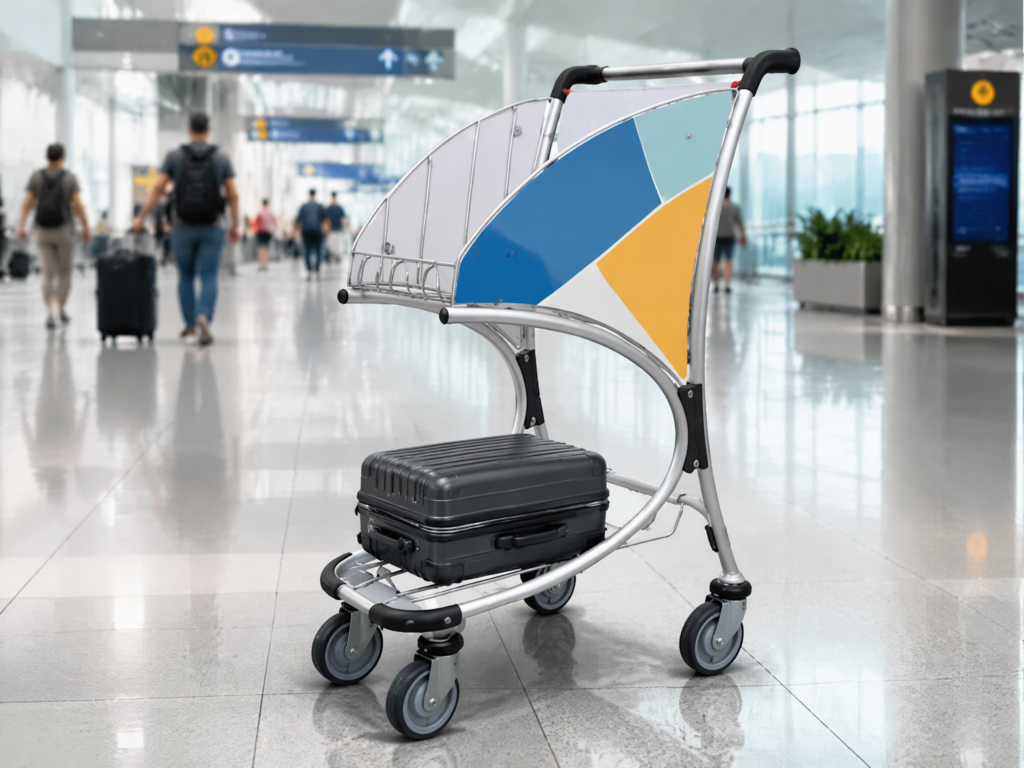
How wheel selection affects everyday airport movement
Wheels are one of the first interfaces between an airport trolley and the terminal floor. A specification review should consider the wheel material stated by the manufacturer, the turning arrangement, noise expectations, floor transitions, and the way the trolley behaves when it is pushed slowly or redirected around people. MINGLE product pages for models such as the CY-X4200-BG3S and CY-X3200-LG5 describe natural rubber noise-reducing wheels and 360-degree swivel movement. These are source-supported product features; they are not a guarantee that every floor, ramp, or passenger route will feel identical.
A 360-degree swivel arrangement can be useful where a trolley must change direction in a reclaim hall, lift lobby, or transfer corridor. However, turning freedom does not remove the need for space. When a trolley is heavily loaded, passengers may need more room to correct its direction, and a route with temporary queues can become difficult to navigate. Procurement teams should observe whether a representative trolley can make common turns without contacting walls, queue rails, seating, doors, or people.
Noise should also be treated as an operational consideration rather than a marketing conclusion. Natural rubber noise-reducing wheels may be relevant in passenger-facing spaces, but the final sound level depends on floor joints, debris, wheel condition, load, speed, and the surrounding terminal environment. A practical evaluation should compare a sample on the actual or representative surfaces used in the airport.
A wheel and route review checklist
Before approving an airport luggage trolley for an accessible passenger route, ask:
- Is the stated wheel material documented on the model page or technical quotation?
- Can the trolley turn within the route’s planned turning area without blocking a doorway or crossing flow?
- Does the wheel arrangement remain controllable when the trolley is lightly loaded and when it carries a typical passenger load?
- Are floor joints, thresholds, ramps, lifts, and wet-weather entrance zones included in the trial route?
- Can staff inspect, clean, and replace wheels without creating an unsafe trolley in service?
- Is there a defined parking position that does not reduce the continuous clear route?
Braking and stopping points in passenger areas
A trolley’s ability to stop is part of route design. MINGLE CY-X4200-BG3S, CY-X3200-LG5, and CY-G4080-BW3 describe a self-adjusting automatic brake lever. That feature can be considered during a procurement evaluation, but the correct operating behavior must be confirmed with the supplier and tested under the airport’s own procedures. This article does not infer a safety rating, braking distance, slope limit, or certification from the product description.
Accessible planning benefits from predictable stopping areas. A trolley left beside an entrance, lift, gate queue, or boarding corridor can become an obstruction even when the trolley itself is easy to push. Airport operations teams should map where passengers naturally pause to reorganize bags, read signs, wait for assistance, or meet companions. Those pause points need enough space for the trolley and the person using it, while preserving the route for wheelchairs, mobility devices, prams, and other passengers.
Use a simple operational test during a sample review. Start with an empty trolley, repeat the route with a representative load, stop at each planned pause point, and observe whether the brake can be engaged without awkward hand movement. Then release the brake and restart without crossing into an adjacent accessible path. Record the surface, slope, load condition, weather condition if relevant, and any interaction with queues. The result is an airport-specific observation, not a universal claim about the model.
Clear width, turning space, and shared passenger routes
The U.S. Access Board’s accessible-route guidance explains that accessible routes connect entrances, accessible spaces, and facilities. It also notes greater clearance for 180-degree turns around narrow obstructions and identifies passing-space provisions. For an airport trolley project, these principles encourage a coordinated layout review rather than a narrow product-only decision.
Start by drawing the route used by a passenger from trolley collection to check-in, security, transfer, or baggage reclaim. Mark doors, columns, queue barriers, retail displays, seating, lifts, moving walkways, and temporary storage. Add the trolley’s footprint, the space needed for a person to stand behind the handle, and the space required to turn. Then add the paths of other users. A route that works for one empty trolley may fail when two passengers meet, a wheelchair needs to pass, or a suitcase falls out and requires a short stop.
MINGLE airport trolley provides BG Series, LG Series, and Shopper product groupings for further product review. It should be used as a product-reference starting point, not as a replacement for a site measurement. The category page’s grouping can help a buyer compare possible families, while the airport’s own access assessment should determine where each family can be trialled.
A practical layout sequence
- Measure the route: Record the narrowest continuous sections, door clearances, turning areas, slopes, and surface changes.
- Map conflicts: Mark queue lines, lift doors, seating, signs, columns, cleaning zones, and trolley parking points.
- Choose a sample: Select a representative model and document its visible frame, handle, basket, wheel arrangement, and brake configuration.
- Run movement trials: Test empty and representative-load conditions through normal passenger paths, including turns and stops.
- Review shared use: Include wheelchair, mobility-aid, pram, staff, and luggage-passing scenarios without claiming a legal compliance result.
- Record actions: Define parking, inspection, cleaning, wheel replacement, and obstruction-response procedures before rollout.
Comparing trolley features with accessibility planning needs
| Procurement question | Product feature to review | Route-planning action |
|---|---|---|
| How will the trolley change direction? | 360-degree swivel wheel description | Trial turns at doors, corners, lifts, and queue edges |
| How will it stop? | Brake type and operating instructions | Test planned pause points and document local procedures |
| How will noise be managed? | Stated wheel material or noise-reduction feature | Compare representative floor surfaces during a normal operating period |
| How will trolleys be stored? | Foldability or nesting description | Measure storage so parked units do not reduce clear routes |
| Which product family fits the use case? | BG, LG, or Shopper category and model details | Match the family to route, load, staff, and passenger observations |
MINGLE airport luggage trolleys pages for the reviewed models also describe high-strength aluminum alloy, stainless-steel baskets, front bumpers, ergonomic flat push handles, one-button folding, nesting, cup holders, and side hooks. Each feature should be checked against the exact model and quotation before procurement. A feature list can guide questions, but it cannot substitute for a site trial or the airport’s own accessibility review.
Maintenance and procurement controls for accessible service
Accessibility can decline when a trolley is damaged, difficult to steer, or parked carelessly. Include service controls in the purchase discussion from the beginning. Ask which replacement parts are available, how wheel and brake inspections should be performed, what cleaning instructions apply to the materials, and how defective units should be removed from passenger areas. Request model-specific operating and maintenance information rather than applying assumptions from another trolley.
A useful handover checklist includes model identification, approved route or trial notes, parking locations, inspection responsibilities, escalation contacts, and a record of unresolved issues. Staff should know how to report a wheel that does not swivel as expected, a brake that does not operate according to instructions, a loose basket, a damaged bumper, or an obstruction caused by parked units. Add a visible quarantine process for units that cannot be steered or stopped as expected, and define who releases a replacement unit. Review observations after seasonal layout changes, construction work, or changes to queue furniture. These controls help preserve the intended route without claiming that a trolley alone makes an airport accessible.
Plan an airport trolley route review with us
If your airport is evaluating airport trolleys for passenger-facing or transfer areas, send MINGLE the route context, preferred product family, sample requirements, and questions about wheels, braking, nesting, and maintenance. Use the Products Series page to review the airport trolley range to start an inquiry. Ask for model-specific documentation and evaluate any sample on the intended route before making a purchasing decision. Include the narrowest measured clear width, the tightest turn, the surface types, the planned parking points, and whether the trial should include wheelchair or pram passing scenarios. Also identify the people who will approve the trial, the date and operating conditions, and the evidence the procurement team needs before moving to a larger order. This information gives the supplier a concrete basis for discussing a suitable sample and quotation without turning a general product page into an unsupported compliance claim. It also creates a clear handoff between facilities, passenger-services, accessibility, safety, and purchasing teams.