
Airport Luggage Trolley Layout Planning for Baggage Reclaim and Check-In Areas
Airport luggage trolleys work best when the product, the passenger route and the storage point are planned together. A trolley that is suitable for a baggage-reclaim exit may not be the best choice for a narrow transfer corridor or a check-in queue. For airport operators, terminal designers and procurement teams, the practical question is not simply which trolley looks strongest. It is how the fleet will be positioned, used, collected and replenished across the passenger journey.
This guide explains how to plan airport luggage trolley layouts for baggage reclaim, check-in and transfer areas. It uses verified product information from MINGLE’s published airport trolley pages, including aluminum and stainless-steel models, three- and four-wheel configurations, basket options, advertising panels and model-specific layouts. It also separates published product facts from project decisions that should be confirmed with the manufacturer before an order.
Why airport trolley layout planning matters
A trolley layout affects more than appearance. It influences whether passengers can find a trolley without blocking a door, whether staff can replenish the fleet efficiently, and whether the available model suits the luggage pattern in that zone. The International Air Transport Association describes baggage operations as a critical part of airline operations and the passenger experience, with bags moving through a complex network of airlines, airports and ground handlers. That wider baggage journey makes the public-facing trolley area one part of a larger operational sequence, not an isolated display point.
Good planning starts by mapping the passenger route. Mark the point where passengers first need a trolley, the direction they naturally walk, the location of baggage reclaim exits, the nearest lift or transfer route, and the point where used trolleys can be returned or collected. Then define the trolley role in each zone. A baggage-reclaim trolley may need a generous lower platform for suitcases. A check-in-area trolley may need a more compact footprint near queue barriers. A transfer-area trolley may need a layout that leaves clear space for people moving in both directions.
The goal is a repeatable system: passengers see where to collect a trolley, staff know where to return or stage it, and the selected model remains appropriate for the physical constraints of the terminal.
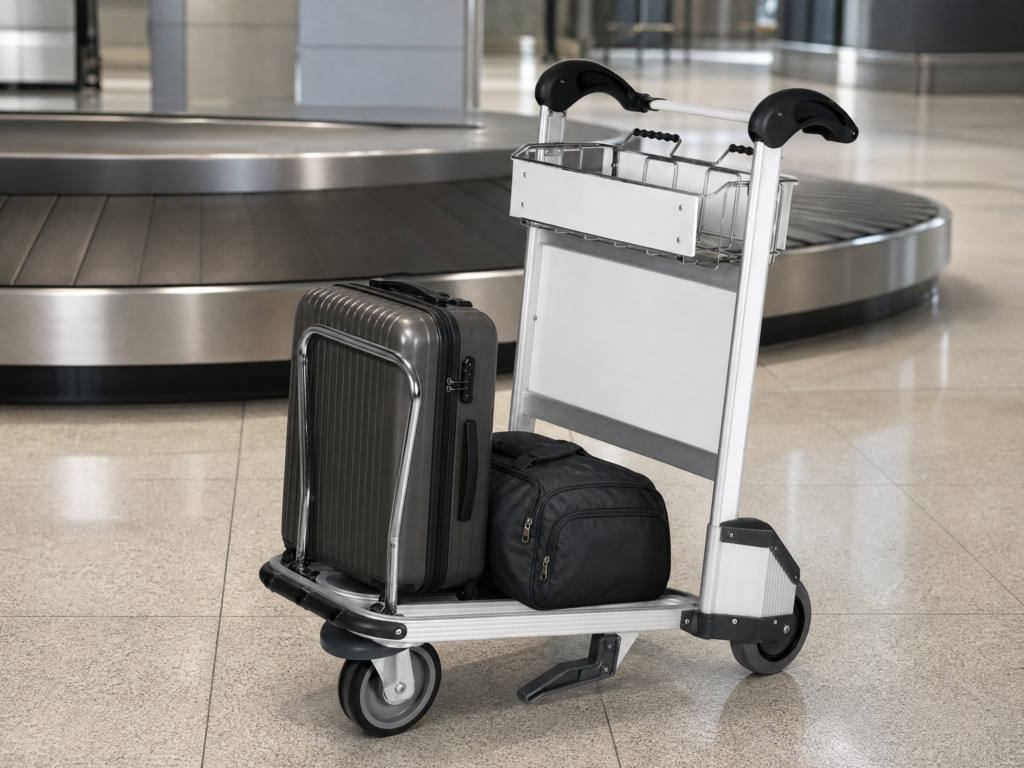
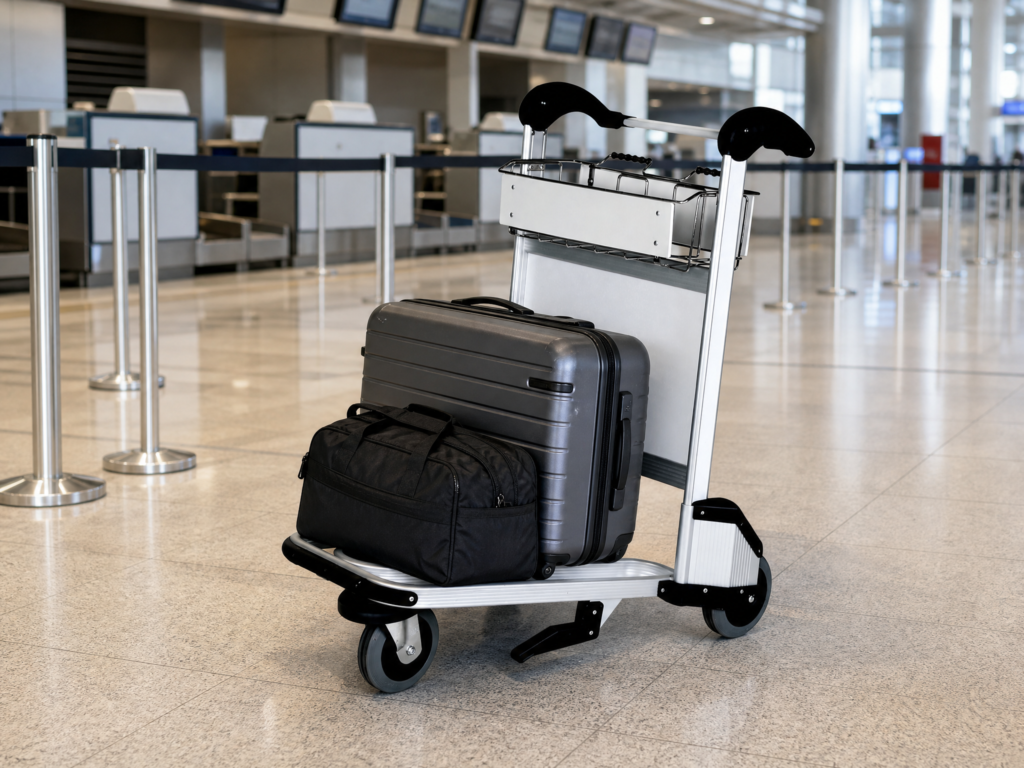
Plan three airport zones separately
Treating the whole terminal as one trolley environment often produces avoidable compromises. Baggage reclaim, check-in and transfer areas have different passenger movements, sightlines and storage needs. A simple zone plan creates a clearer specification for the supplier.
Baggage-reclaim exits
At baggage reclaim, passengers usually leave the carousel area carrying or pulling bags of different sizes. The trolley position should be visible after the reclaim process, but it should not narrow the exit route or create a conflict with doors, columns or queue rails. Place the collection point where passengers can approach from more than one direction while keeping a defined pedestrian path beside it.
The trolley specification should focus on the luggage platform, wheel arrangement, handle position and the amount of space required for a user to load a case. A model such as the published four-wheel CY-X4200-BG3 has a stainless-steel 304 specification, a 180 mm natural-rubber wheel specification, a basket option of powder-coated steel or stainless steel, and multiple advertising-panel areas. Those published details make it a relevant model for a procurement comparison, but they do not by themselves determine the correct quantity or final layout. The airport still needs to check clearances, local operating rules and the intended loading pattern.
Use this baggage-reclaim checklist:
- Locate the trolley point outside the main passenger discharge path.
- Keep enough room for a passenger to approach, turn and load a suitcase.
- Check that nearby columns, doors and queue barriers do not hide the collection point.
- Define where staff will stage nested or returned trolleys.
- Confirm whether advertising panels must remain blank, carry a campaign or use a replaceable graphic.
- Ask the supplier to confirm the final model configuration before issuing a purchase order.
Check-in and departure queues
Check-in halls create a different problem. Passengers may be standing in queues, moving between self-service machines, baggage-drop points and airline counters. A trolley that is easy to load but too wide for the queue geometry can reduce usable circulation space. In this zone, map the trolley position against queue barriers and self-service equipment rather than choosing a collection point from a floor plan alone.
A lighter aluminum option can be considered where the operating brief prioritizes a lower-weight product. MINGLE publishes the CY-X3200-LG5 as a three-wheel aluminum airport luggage trolley using 6063 high-strength aluminum alloy, a 180 mm natural-rubber wheel specification, and a basket option of powder-coated steel or stainless steel. Its published large advertising-board reference is 525 × 354 mm. These are product-page facts, not a universal recommendation. The final selection should match the airport’s required basket, panel, wheel and handle configuration.
For check-in planning, compare:
| Planning question | Why it matters | Evidence to confirm |
|---|---|---|
| How close is the trolley to queue barriers? | Prevents the collection point from narrowing the queue | Scaled layout and on-site walk-through |
| Will passengers load one large case or several bags? | Influences platform and basket priorities | Passenger and baggage-use brief |
| Is a three- or four-wheel layout preferred? | Changes the handling pattern and footprint | Supplier drawing and operational trial |
| Is the advertising panel part of the brief? | Affects visual communication and artwork handover | Published model page and approved artwork template |
| How will returned trolleys be staged? | Prevents abandoned equipment from obstructing circulation | Staff collection route |
Transfer corridors and vertical transport
Transfer corridors require more attention to turning space and conflicts with other passenger flows. A trolley point near an escalator, lift lobby or corridor junction should be positioned so that passengers can pause without stopping directly in the walking line. If the terminal includes a vertical-transport route, the project team should confirm whether a standard passenger trolley is suitable or whether a specialized configuration is required.
MINGLE publishes an Elevator Trolley as a separate product page. The page identifies it as part of the Airport Trolley and BG Series categories, but it does not publish a full technical table in the retrieved content. That means a buyer should not infer dimensions, load limits or operating instructions from the product name alone. Request the current technical drawing, intended use instructions and site compatibility information before treating it as a specification for an elevator area.
For a transfer-zone layout, record the direction of travel, the width of the clear route, the location of lifts and escalators, and the point where staff can collect used trolleys. If the trolley is intended for a special vertical-transport workflow, include the operator, facilities team and supplier in the design review.
Match product configuration to the operating brief
Once the zones are mapped, compare product configurations against the job each area requires. Avoid selecting a model because it is visually similar to another model. The published MINGLE range includes both BG and LG families, and the products page lists models such as CY-X3200-BG3, CY-X3200-LG5, CY-X4200-BG3, CY-X4200-BG5S, CY-X4200-LG5 and Elevator Trolley.
The MINGLE provides the range overview. The LG Series lists the published LG models, while individual pages provide the most useful product-level details. For example, the CY-X3200-BG3 publishes a three-wheel aluminum specification, basket-material options and the 525 × 354 mm large advertising-board reference. The CY-X4200-BG3 publishes a four-wheel stainless-steel 304 specification, a 25 kg net-weight reference, 180 mm natural-rubber wheels and several advertising areas.
Use a product comparison request that asks the supplier to confirm the same fields for every shortlisted model:
- Product name and current model version.
- Main frame material and basket material.
- Number and material specification of wheels.
- Handle type and any visible brake or guard configuration.
- Advertising-panel locations and confirmed artwork dimensions.
- Overall dimensions, nesting or staging requirements and delivery configuration.
- Available finish or color options, if relevant to the project.
- Replacement-part and after-sales information for the intended market.
This approach reduces the risk of comparing a current model with an older model or using a product photograph as if it were a complete technical drawing.
Build a practical trolley-point specification
A trolley layout specification should be useful to procurement, design and operations teams. Begin with a plan drawing that shows the trolley point, the passenger route, nearby doors, barriers, columns, counters and emergency circulation. Add a short written brief that explains how the location is expected to work during a normal operating period and during a busy arrival wave.
Then define the fleet-control method. Decide whether staff will push nested trolleys to the point, whether several collection points will feed one return route, and who is responsible for removing damaged or unsuitable units. The specification should also identify the required signage position without putting unverified claims on the product itself.
For advertising-board models, keep the physical panel specification and the creative brief separate. MINGLE product pages publish reference panel dimensions for some models, but the final visible area, mounting method, artwork file format and proofing process should be confirmed against the selected model. Do not send a single artwork file to production for several trolley models unless the supplier has confirmed that their panels and mounting details match.
A useful procurement pack includes:
- A zone plan with trolley collection and return points.
- A schedule of shortlisted models and links to their product pages.
- A table of confirmed materials, wheels, baskets, handles and panels.
- A passenger-flow note for baggage reclaim, check-in and transfer zones.
- A cleaning, inspection and damaged-unit escalation process.
- A request for current drawings, samples or photographs where the public product page is incomplete.
- A single contact point for quotation, artwork and technical questions.
Common layout mistakes to avoid
The first mistake is placing trolleys where passengers naturally stop without checking the width of the surrounding route. This can create a bottleneck even when the trolley itself is well designed. The second is mixing models with visibly different handles, panels or wheel arrangements in one public collection point without a reason. Mixed fleets can be appropriate, but the operating team should know which model belongs in which zone.
The third mistake is treating published specifications as a substitute for site verification. Product pages are useful evidence, but they may not include every dimension, current drawing or operating instruction. The CY-X4200-LG5 product page publishes a 6063 high-strength aluminum-alloy reference, a 525 × 354 mm large advertising-board reference, 180 mm natural-rubber wheels, basket-material options and an ergonomic flat handle with fish-shape connector. A procurement team should still request a current drawing and confirmation that the selected production configuration matches the page.
The fourth mistake is adding unsupported claims to marketing copy. Avoid saying that a model is certified, maintenance-free, suitable for every airport or used by a named airport unless the evidence is available. A precise article and a precise quotation request build more trust than a longer list of unverified benefits.
Final pre-order checklist
Before the airport issues a purchase order, complete one final review with procurement, operations, facilities and the supplier. Confirm the exact model code, current version and quantity by zone. Confirm that the trolley point fits the measured terminal route, not only the concept drawing. Check how passengers will approach, load and leave the point. Confirm where staff will stage returned units and how damaged units will be removed.
Next, reconcile the product evidence. Match every material, wheel, basket, handle and advertising-panel statement to a published product page, approved drawing or written supplier confirmation. If a value is not published, mark it as “to be confirmed” instead of filling the gap with an assumption. For a special product such as the Elevator Trolley, ask for the complete technical package before approving the application.
Finally, prepare the commercial enquiry in one message. Include the airport region, zone plan, target models, estimated quantity by zone, desired delivery timing, artwork requirements and the questions that need written confirmation. This gives the manufacturer enough context to recommend a suitable configuration without forcing the buyer to repeat the project details across several conversations.
Request an airport trolley layout quotation
If you are planning trolley points for baggage reclaim, check-in, transfer corridors or a special vertical-transport area, send MINGLE your terminal zone plan and the required operating context. Include the target airport region, the intended trolley locations, luggage pattern, advertising requirements and shortlisted models. MINGLE can then confirm current product details, propose a suitable configuration and prepare a quotation based on your actual project brief. Visit the Airport Trolleys product range or contact the manufacturer for product details, pricing and personalized solutions.
For a useful first quotation, attach a simple marked-up plan rather than sending only a product name. Show the baggage-reclaim exits, check-in barriers, transfer corridors, lift or escalator locations, trolley collection points and any area where staff will stage returned units. Add the approximate number of trolley points, the preferred material or model family, the required basket option, the advertising-panel intention and any known access restrictions. If the project is still at concept stage, say which measurements remain to be confirmed. This helps keep the quotation transparent and prevents a preliminary product suggestion from being mistaken for a final site approval.
Ask for written confirmation of the current model version, product dimensions, wheel and basket configuration, panel dimensions, available finishes, packing method, lead-time assumptions and after-sales contact. For special applications, request the relevant drawing and operating information before approval. A detailed enquiry gives the manufacturer a clearer basis for recommending airport luggage trolleys and gives the airport team a documented list of decisions to review.
Website: https://airport-trolley.com/products-series/
Email: sales02@gdmingle.com
WhatsApp: +86 133 9224 9161