
How Airport Luggage Trolleys Support Passenger Flow and Airport Projects
Airport luggage trolleys support passenger flow by giving travelers a controlled way to move baggage between terminal entrances, check-in, departure routes, baggage claim, and vehicle pickup areas. To select one, map the passenger journey first, then match the trolley’s material, wheel layout, basket, handle, brake or panel requirements to that route. This article combines documented MINGLE model information, published project-page claims, IATA baggage context, and clearly labelled regional planning scenarios. It does not claim that an unnamed airport uses MINGLE equipment.
Passenger flow begins with the baggage journey
A trolley is a passenger-facing asset within a wider baggage system. IATA describes baggage operations as a critical part of airline operations and passenger experience, with bags moving through airlines, airports, and ground handlers. Its passenger-experience work also describes the industry goal of a more seamless, inclusive, secure passenger process. Read IATA’s Baggage Operations page and Passenger Experience & Policy overview for that broader industry background.
This background helps define the trolley’s job. At the terminal entrance, a trolley must be easy to find and start using. Along the route to check-in, it should move predictably around people and fixtures. Near baggage claim, it should accommodate the passenger’s luggage pattern without blocking circulation. At pickup or parking interfaces, the operating team may need clear rules for storage, branding, and return.
The trolley does not manage checked baggage inside the airline or airport system. It helps the passenger move personal baggage before or after those controlled processes. That distinction keeps a product article accurate and prevents a passenger trolley from being described as baggage-handling automation.
Match the trolley configuration to the airport scene
Arrival and departure entrances
At an entrance, passengers may arrive with several cases, hand luggage, children’s items, and personal belongings. A basket can provide a separate place for small items, while the lower platform carries larger baggage. Clear handle design and a stable wheel configuration matter because the user may be unfamiliar with the trolley and focused on wayfinding.
For a new project, ask operations to observe the route from vehicle drop-off to check-in and from baggage claim to pickup. Record surface transitions, turning points, ramps, doors, queue lines, and trolley return points. Then request a sample or drawing that can be reviewed by operations, cleaning, safety, accessibility, and procurement teams.
Check-in and departure routes
In departure areas, trolleys pass through queues and shared passenger spaces. The buyer should define where trolleys may be parked, how they are nested, whether advertising panels obstruct visibility, and how the trolley interacts with staff routes. A smooth-rolling wheel is useful, but the supplier must confirm the complete assembly and the airport must confirm operating rules.
Baggage claim and terminal exit
At arrival, the trolley may carry multiple checked bags and smaller personal items while the passenger leaves the reclaim area. The route may cross polished floors, constrained doors, or a crowded public hall. Specify the basket, platform, handle, wheel, and brake requirements for the actual model rather than assuming that a generic “heavy-duty” label is enough.
Parking, hotel, and transport interfaces
Some airports connect terminal movement with parking, shuttle, rail, hotel, or other ground-transport interfaces. These are planning scenarios, not claims that MINGLE equipment is installed at a particular interface. Ask whether the trolley will be exposed to outdoor transitions, uneven surfaces, rain, dust, cleaning chemicals, or longer storage periods. Confirm the metal grade, surface finish, wheel assembly, and any brake or identification requirements with the supplier.
Materials and parts influence passenger use
Aluminum structures
The CY-X4200-LG5 identifies a three-wheel trolley with a 6063 high-strength aluminum alloy structure. It also lists a powder-coated steel or stainless-steel basket, 180 mm natural-rubber wheels, an ergonomic flat handle with a fish-shape connector, and a 525 × 354 mm large advertising board.
For a project team, this provides a documented example of how material, wheel count, basket, handle, and panel form one configuration. It does not establish the correct choice for every entrance or terminal. Ask whether the three-wheel layout, alloy structure, basket option, and panel are appropriate for the route you mapped.
Stainless steel structures
The CY-X4200-BG3 identifies a four-wheel stainless steel 304 trolley with a listed net weight of 25 KG. It lists a powder-coated steel or stainless-steel basket, 180 mm natural-rubber wheels, and an ergonomic flat handle with a fish-shape connector. Its listed advertising spaces are two 490 × 430 mm main panels, a 480 × 120 mm front-of-basket area, and a 480 × 140 mm back-of-basket area.
A four-wheel stainless-steel example may be useful when an airport wants to compare a different physical configuration and a clearly specified metal grade. Do not infer that stainless steel automatically provides a certain service life, outdoor rating, or maintenance outcome. Those points require the supplier’s technical confirmation and the airport’s environmental review.
Baskets and small items
A basket changes the passenger interaction because phones, documents, water bottles, or smaller bags can be separated from larger cases. The reviewed model pages list powder-coated steel or stainless-steel basket options. A procurement brief should ask for the basket drawing, attachment, edge treatment, internal clearance, and cleaning instructions.
Wheels and handles
The two product pages list 180 mm natural-rubber wheels and an ergonomic flat handle with a fish-shape connector. Use those details to compare the models, but do not equate a shared wheel diameter with identical movement. Confirm wheel count, swivel or fixed arrangement, mounting, brakes, floor suitability, and replacement parts for the chosen model.
Product series and configuration choices
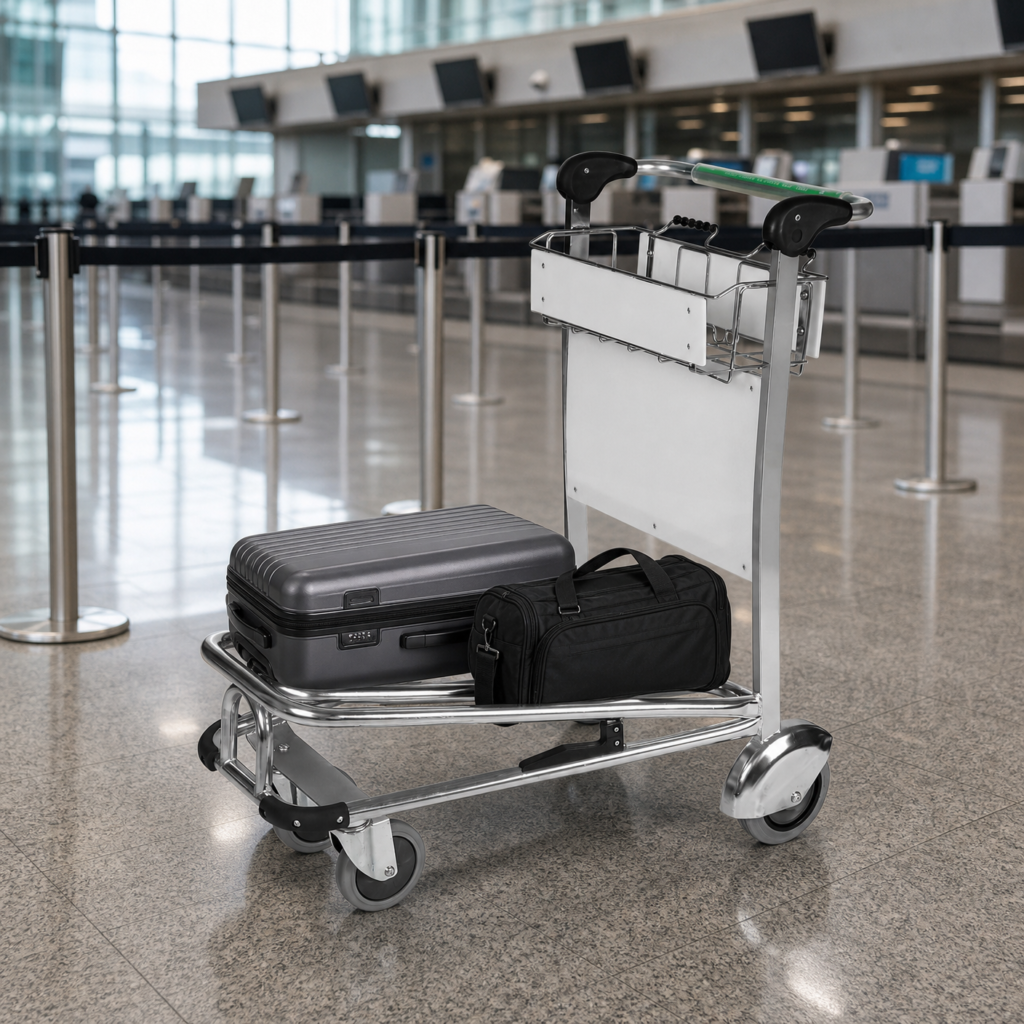
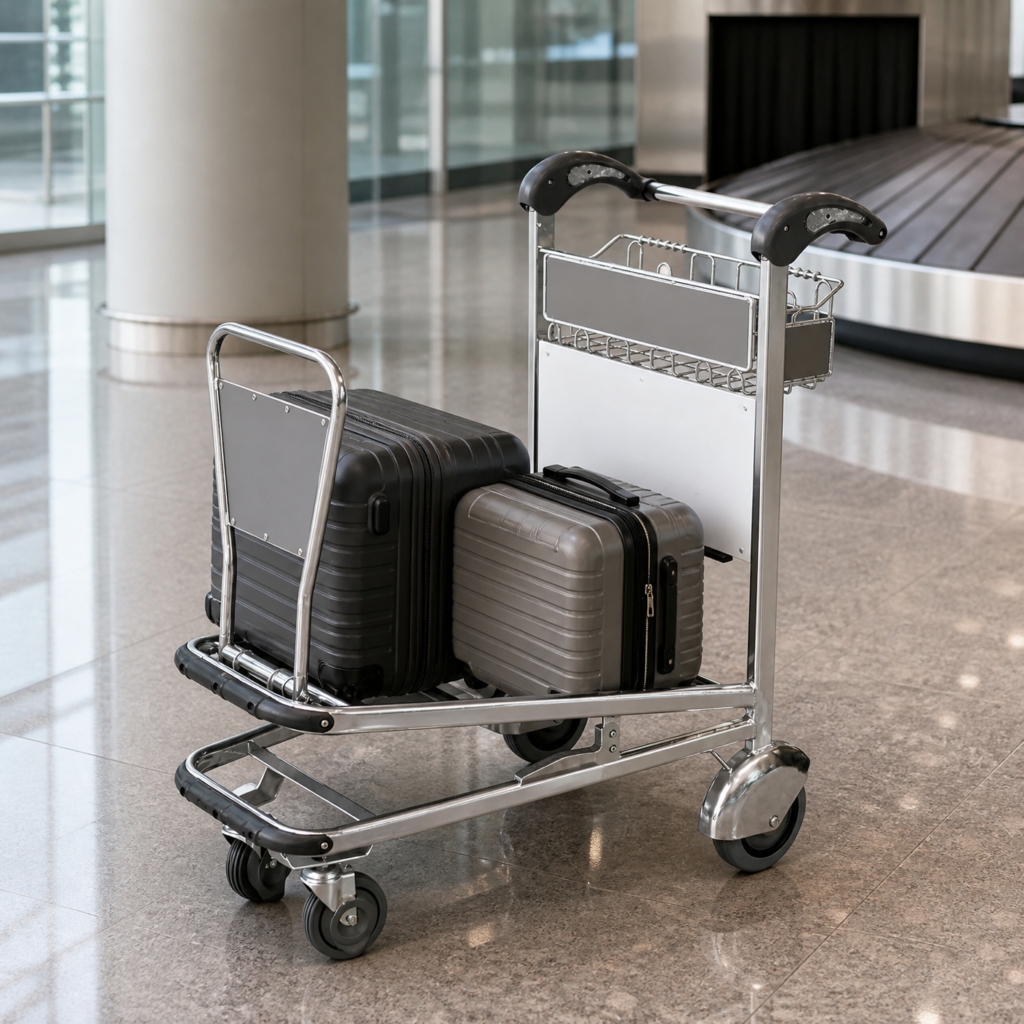
The MINGLE luggage trolley groups the range into BG Series, LG Series, and Shopper. The page describes BG as lightweight, durable, and smooth-rolling; LG as designed to make heavy loads easier, safer, and more efficient; and Shopper as robust, adaptable, and tailorable to a process.
The LG Series lists seven products. Use it to understand the family, then move to the individual model page for confirmed materials and dimensions. The general airport trolley lists multiple BG and LG models, including CY-X3200 variants and CY-G4060/CY-G4080 variants. A category list is a starting point, not proof that all models share a specification.
| Airport scene | Questions for the trolley brief | Evidence to request |
|---|---|---|
| Entrance to check-in | Is the layout easy to start, turn, park, and return? | Sample, route review, handle and wheel drawing |
| Baggage claim to exit | What baggage mix, basket use, and storage rules apply? | Platform and basket dimensions, model confirmation |
| Departure queues | Will panels, handles, and nesting work without obstructing circulation? | Panel drawing, nesting information, operating guidance |
| Parking or transport interface | What weather, surface, cleaning, and security conditions apply? | Material and finish confirmation, wheel and brake details |
| Branded fleet or sponsorship | Where can logos, instructions, or advertising be placed? | Approved artwork template and panel construction |
Verified MINGLE project references
The following examples are based on pages actually read on the MINGLE site. They are presented as published project references, not as independent audits or universal product claims.
Entebbe International Airport, Uganda
The page titled MINGLE Airport Luggage Trolleys Delivered to Entebbe International Airport, Uganda states that MINGLE completed bulk production and shipment of custom stainless-steel airport luggage trolleys for the Ugandan aviation market. It describes curved black handles, a wire basket, a blank white advertising panel, foot-operated braking, and a stated project capacity. Those statements are specific to the published case page. The page does not establish that CY-X4200-BG3 was the delivered model, so this article does not make that connection.
BENINA INTERNATIONAL AIRPORT
The BENINA project page states that MINGLE provided professional airport trolley solutions and describes customized trolleys with lightweight aluminum structures, smooth mobility, and passenger-friendly features. It presents the airport as a named project reference. It does not provide enough detail to identify every component or to support a claim about a particular CY-X4200 model.
Sirte Gulf Airport, Libya
The Sirte Gulf Airport states that MINGLE completed production and container shipment of a customized airport luggage trolley for Sirte Gulf Airport in Libya. It mentions airport logo printing and bilingual Arabic and English markings. This is a useful example of a project where language and identity were part of the configuration; it is not evidence that every North African airport requires the same design.
Guangzhou Baiyun International Airport
The Baiyun project states that MINGLE provided more than 1,000 airport luggage trolleys to Guangzhou Baiyun International Airport. Use this as a published MINGLE case reference with the quantity stated on that page. Do not treat the figure as a current tender requirement, a capacity claim for another project, or a specification for a particular model unless separate documentation confirms it.
India and Adani Group
The India and Adani states that Adani Group placed an order for more than 10,000 airport luggage trolleys and names several Indian airport locations. Because the public pages use different figures and wording, present these as MINGLE’s published claims and ask for current project documentation before using a number in a procurement decision.
Regional planning examples, not unverified customer claims
African airport planning scenario
A regional airport or terminal contractor in Africa can use the Entebbe, BENINA, and Sirte Gulf pages as references for questions about stainless steel, aluminum, branding, bilingual markings, baskets, brakes, and shipment coordination. The buyer should still map the route and request a model-specific quotation. Unless a source names the airport, do not write that MINGLE supplies a particular airport in Kenya, Tanzania, Ethiopia, or another country.
Southeast Asian airport planning scenario
The Indonesia project page describes custom aluminum airport trolleys for Indonesian airport projects and discusses tropical-humidity planning, passenger guidance, a basket, branding, and a brake system. The text reviewed does not identify a specific airport customer. Therefore, use Indonesia as a regional planning example rather than claiming installation at Jakarta, Bali, Surabaya, or another named airport.
Indian airport procurement scenario
The Adani page is a named MINGLE project reference, but a new Indian buyer should not copy its alleged fleet size or model. Define the airports, terminal zones, passenger routes, materials, basket and wheel requirements, branding, languages, documentation, and acceptance process. Use the published case only to begin a supplier conversation.
Procurement checklist for passenger-flow projects
Before requesting a quote, gather:
- Route map: entrance, check-in, baggage claim, exit, parking, shuttle, rail, or hotel interface.
- Passenger profile: typical baggage mix, family use, accessibility considerations, and first-time-user needs.
- Material brief: aluminum, stainless steel, steel basket, stainless basket, finish, cleaning, and environment.
- Movement brief: wheel count, wheel material, turning, floor type, ramps, doorways, and brake requirements.
- Storage brief: nesting, return points, parking areas, and staff handling.
- Identity brief: airport logo, instructions, languages, advertising panels, and identification marks.
- Evidence pack: model page, drawing, sample, inspection plan, packaging, and delivery documentation.
- Case-reference request: ask which named project examples match the proposed model and configuration.
Ask for a route-based trolley proposal
A useful route-based inquiry should identify the passenger journey, surface transitions, trolley storage points, material preference, basket and wheel requirements, branding, languages, brake needs, and acceptance documents. Ask the supplier to connect each recommendation to a named model page or a project drawing, and to distinguish standard features from custom work.
For a new terminal, replacement fleet, or regional airport procurement, send MINGLE a route map and a written configuration brief. Start with the products series, compare the LG Series, and include the exact CY-X4200-LG5 and CY-X4200-BG3 pages when those models are under consideration. Describe where passengers will push, park, turn, load, and return the trolley, then ask which materials, basket, wheel, handle, panel, and brake configurations are standard or custom. This gives the supplier a factual basis for an airport trolley quotation and keeps regional planning examples separate from verified customer evidence.
Website: https://airport-trolley.com/products-series/
Email: sales02@gdmingle.com
WhatsApp: +86 133 9224 9161