
MINGLE Airport Luggage Trolleys: Materials, Uses, and Model Selection
If you are selecting airport luggage trolleys, start with the operating scene and the material specification: aluminum can support a lighter three-wheel configuration, while stainless steel can suit a four-wheel trolley intended for a different fleet brief. Then compare basket construction, wheels, handle design, advertising space, braking requirements, and documentation. This guide explains those decisions using published MINGLE product information and clearly labelled project-page references. It does not promise a universal load rating, service life, certification, or performance result where the reviewed page does not state one.
Why material selection matters in an airport trolley brief
A luggage trolley is used across arrival halls, departure areas, baggage-claim approaches, drop-off zones, parking interfaces, and other passenger routes. It must move baggage while remaining understandable to a first-time user. Material is therefore not an isolated purchasing choice. It affects the trolley’s visible finish, weight, corrosion considerations, basket options, cleaning discussion, and the way a supplier describes the model in a quotation.
IATA describes baggage operations as critical to both airline operations and passenger experience, with bags moving through a complex network of airlines, airports, and ground handlers. That industry background does not specify a trolley material, but it explains why a trolley procurement brief should be connected to the full passenger and baggage journey rather than judged only from a showroom photograph. See IATA’s Baggage Operations for the broader baggage context.
The practical question is not “Which material is always best?” It is “Which documented construction and configuration fit this terminal, this passenger route, and this procurement requirement?”
Aluminum airport luggage trolleys: when a lighter configuration is useful
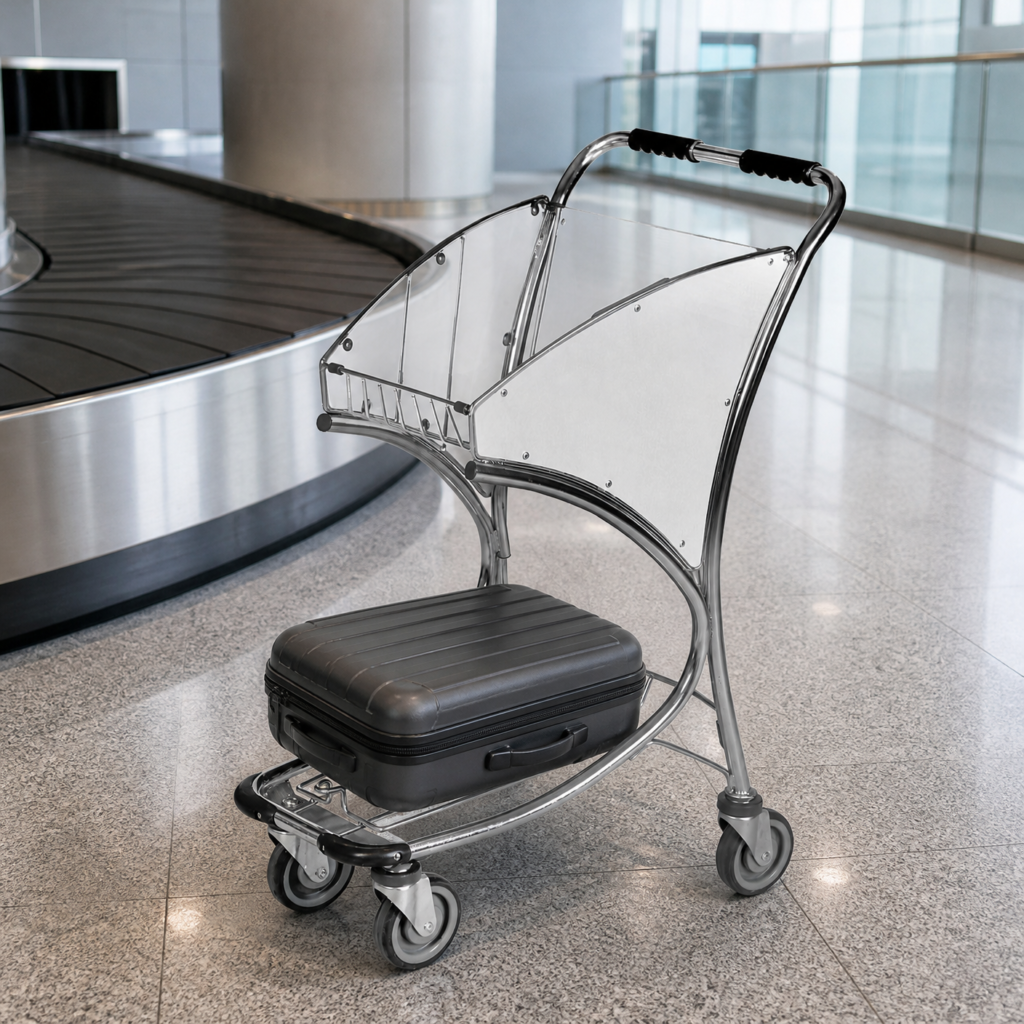
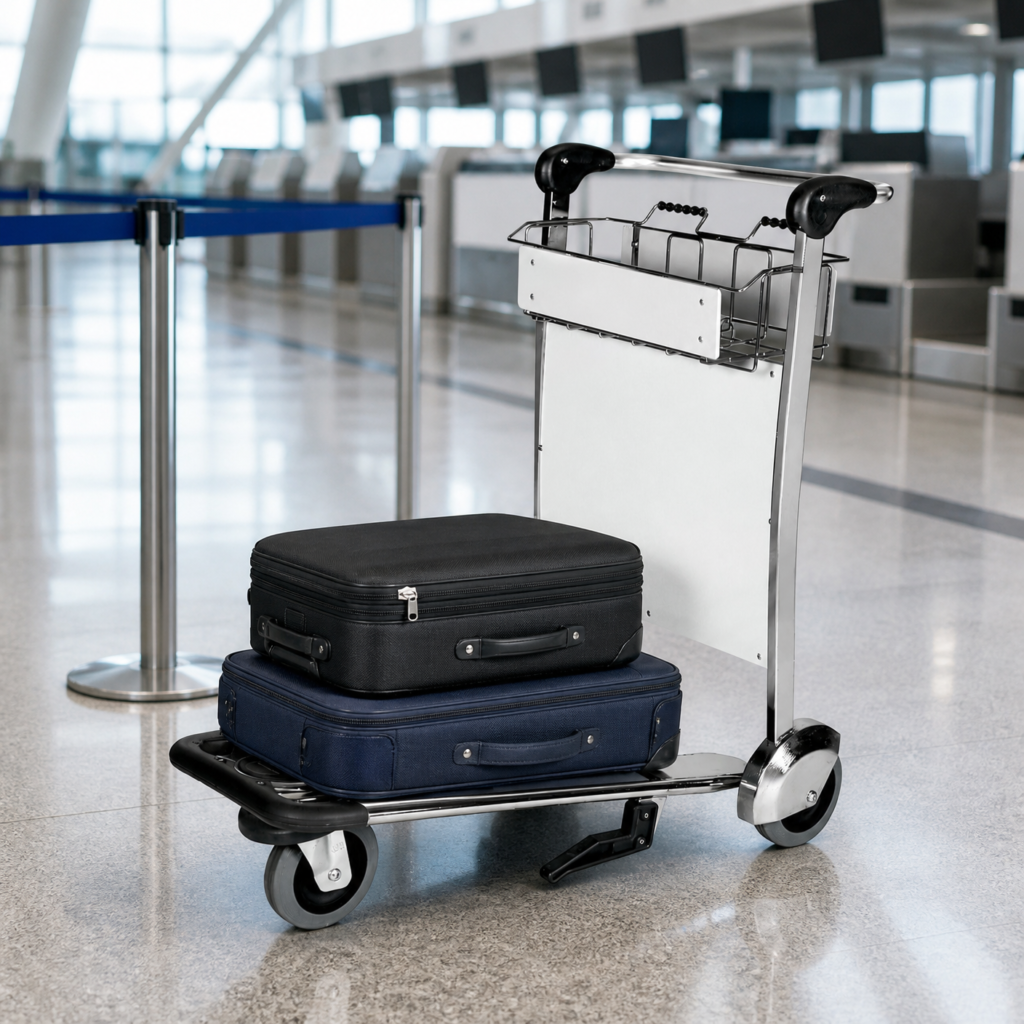
The published CY-X4200-LG5 product page identifies a three-wheel airport luggage trolley with a 6063 high-strength aluminum alloy structure. It lists a 180 mm natural-rubber wheel, a powder-coated steel or stainless-steel basket, an ergonomic flat handle with a fish-shape connector, and a large advertising board listed as 525 × 354 mm.
Those are product facts for that model, not a general claim about every LG trolley. For a procurement team, the page provides a useful checklist of questions:
- Is a three-wheel layout appropriate for the intended passenger route and turning points?
- Does the project require the listed aluminum alloy construction or another documented specification?
- Should the basket be powder-coated steel or stainless steel?
- Is the large advertising board part of the operating brief, or is a blank or different panel required?
- Does the buyer need a sample, drawing, or configuration confirmation before tender approval?
An aluminum configuration may be considered for terminals where easy maneuverability and a lighter-feeling passenger interaction are important. That is a planning scenario, not a manufacturer-stated performance guarantee. The right decision still depends on the actual specification, wheel assembly, floor conditions, passenger behavior, and airport operating rules.
Stainless steel airport luggage trolleys: when a robust visible finish is prioritized
The published CY-X4200-BG3 identifies a four-wheel stainless-steel airport luggage trolley made from stainless steel 304. It lists a net weight of 25 KG, 180 mm natural-rubber wheels, a powder-coated steel or stainless-steel basket, and an ergonomic flat handle with a fish-shape connector. Its advertising information lists two main panels at 490 × 430 mm, a basket-front area at 480 × 120 mm, and a basket-back area at 480 × 140 mm.
A stainless-steel specification can be relevant where the buyer wants a metal finish that is easy to identify in the fleet brief and suitable for a high-visibility public asset. Do not turn that observation into an unsupported promise of corrosion resistance, life, or outdoor performance. Confirm the exact grade, surface finish, welding, cleaning requirements, and project environment with the supplier.
The four-wheel layout also changes the selection conversation. Ask how the trolley will be stored, nested, moved through doorways, and positioned near baggage areas. Review the wheel and brake configuration separately; the product page lists the wheel material and diameter, but a general page statement should not be treated as approval for an unlisted substitution.
Basket, wheel, handle, and panel choices are part of the material decision
Basket construction
Both referenced product pages list a powder-coated steel or stainless-steel basket option. A basket is not just a decorative accessory. It can hold smaller personal items and changes the way passengers use the trolley. In a specification, identify the basket material, dimensions, attachment method, edge treatment, and whether the chosen option applies to the whole fleet or only a model variant.
Wheels and movement
Both CY-X4200-LG5 and CY-X4200-BG3 pages list 180 mm natural-rubber wheels. Record that as a model reference, then ask the supplier to confirm the complete wheel assembly, mounting, and suitability for the actual floor and route. Do not infer load capacity, noise level, rolling resistance, or replacement compatibility from diameter alone.
Handle and user guidance
Both pages describe an ergonomic flat handle with a fish-shape connector. The handle is the passenger’s primary contact point, so a tender should request drawings or samples that show grip shape, connector construction, clearance, and any printed instructions. If a project serves passengers with different heights or physical abilities, ask the airport’s accessibility and operations teams to review the user interaction. A trolley is not a substitute for required airport assistance services.
Advertising and identification panels
The listed panel dimensions can support branding or operational identification, but the product pages do not state bleed, safe-area, substrate, or print-process requirements. Treat the dimensions as a reference for the selected model. Ask for a production drawing before approving artwork, especially when a panel, basket, frame, or handle may obscure part of a message.
Compare the LG, BG, and Shopper series before choosing a model
Airport Trolleys describes three product families: BG Series, LG Series, and Shopper. It characterizes BG as lightweight, durable, and smooth-rolling; LG as intended to make heavy loads easier, safer, and more efficient to move; and Shopper as robust, adaptable, and tailorable to a process. These are series-level descriptions, not a substitute for a model specification.
The LG Series shows seven listed results. A category page helps a buyer see the family and available models, but the individual product page is the source to use for a specific material, wheel, handle, or panel detail.
| Selection question | LG or aluminum scenario | BG or stainless-steel scenario | Shopper scenario |
|---|---|---|---|
| What is the starting product discussion? | Review the three-wheel CY-X4200-LG5 specification and its aluminum structure. | Review the four-wheel CY-X4200-BG3 specification and stainless steel 304. | Request the exact dimensions and intended process because the series page describes Shopper as adaptable and tailorable. |
| What should be confirmed? | Alloy, basket option, wheel assembly, handle, advertising board, and route suitability. | Steel grade, basket option, wheel assembly, handle, panel arrangement, and cleaning brief. | Custom dimensions, branding, operating task, nesting/storage, and any special accessories. |
| What should not be assumed? | That every LG model has the same material or wheel configuration. | That every BG model has the same weight, panels, or brake arrangement. | That “customizable” means a specification has already been approved. |
Verified project references and what they actually prove
A responsible article separates a published case reference from a regional suggestion. The following airport names appear on MINGLE’s own project pages, so they can be cited as published project claims. They should not be expanded with extra facts that the pages do not state.
- Entebbe International Airport, Uganda: the published page says MINGLE completed bulk production and shipment of custom stainless-steel airport luggage trolleys for the Ugandan aviation market. It describes black curved handles, a wire basket, a blank advertising panel, and a stated project load capacity. Because those details come from a case page rather than the CY-X4200 product pages, do not assume that the Entebbe configuration is the same as CY-X4200-BG3.
- BENINA INTERNATIONAL AIRPORT: the published page identifies a MINGLE airport trolley solution and describes customized trolleys with lightweight aluminum structures, smooth mobility, and passenger-oriented features. It is a project-page reference, not evidence that every aluminum model is supplied to every airport.
- Sirte Gulf Airport in Libya: the published page states that MINGLE completed production and container shipment of a customized airport luggage trolley for the airport and mentions logo printing and bilingual Arabic and English markings. Treat this as a published shipment case, not as a universal configuration.
- Guangzhou Baiyun International Airport: the published page states that MINGLE provided more than 1,000 airport luggage trolleys to Baiyun Airport. The quantity is reported on that page; it is not a specification for a new order and should not be generalized to another terminal.
- India and Adani Group: the About Us page says India’s Adani Group purchased more than 15,000 airport trolleys, while a separate project page claims an order of more than 10,000 and names several Indian airports. These are public MINGLE claims with different wording. A buyer should request current tender documents and a model-specific reference rather than treating the figures as a verified fleet count for every named airport.
The reviewed public project pages do not provide a named Southeast Asian airport customer with the same level of specific identification. The Indonesia page is best used as a regional project description and sourcing scenario unless the buyer receives project documentation confirming a particular airport name.
Regional procurement scenarios without overclaiming
Africa
For an African airport project, the procurement team can use the published Entebbe, BENINA, and Sirte Gulf pages as supplier case references, while asking for the exact model, material, wheel assembly, branding files, and shipping documentation. Do not state that an airport in Kenya, Tanzania, Ethiopia, or another country uses the product unless a source names that airport and supports the claim.
Southeast Asia
Indonesia and similar Southeast Asian markets can be treated as a climate and passenger-flow planning scenario. Ask about the selected metal, basket, surface finish, drainage or cleaning considerations, wheel compatibility, and storage. The MINGLE Indonesia page describes a custom aluminum project for Indonesian airport projects, but it does not name a specific airport in the text reviewed here. Say “for Indonesian airport projects” rather than naming Jakarta, Bali, or Surabaya as customers.
India and South Asia
The public Adani page supplies a named customer reference and a claimed large-scale procurement. Use it as a published case reference, then separate it from a new buyer’s requirements. A new airport group should still define its terminal locations, fleet mix, material preference, panel or branding needs, and acceptance documents.
Buyer checklist for a model-specific quotation
Before asking for a final quotation, prepare:
- airport, terminal, and operating zones;
- arrival, departure, baggage-claim, parking, or transfer use;
- expected passenger interaction and storage method;
- preferred series or shortlisted model;
- frame and basket material requirements;
- wheel diameter and material as a reference, not an unverified substitution rule;
- handle, brake, and safety-document requirements;
- advertising, logo, language, and identification needs;
- environmental and cleaning conditions;
- sample, drawing, inspection, packaging, and delivery documentation;
- requested spare-parts and after-sales information.
Ask the supplier to mark each item as standard, optional, custom, or requiring confirmation. This prevents a series description from being mistaken for a finished tender specification.
Request a material and model recommendation
A useful inquiry should identify the terminal route, product family, model, material, basket, wheel and handle configuration, branding, environmental conditions, and evidence required for approval. Include the published project reference you want the supplier to clarify, and ask the supplier to mark each requested feature as standard, optional, or custom.
If you are planning an international airport terminal, a regional gateway, or a trolley replacement program, send MINGLE a structured brief rather than only a target quantity. Use the products series page and LG Series category to identify candidate families, then link the exact CY-X4200-LG5 or CY-X4200-BG3 page in the inquiry. State the intended airport scenes, material preference, basket and wheel requirements, branding, and required evidence. MINGLE can then confirm which parts of the proposal are standard, optional, or custom instead of leaving the buyer to infer them from a photograph.
Website: https://airport-trolley.com/products-series/
Email: sales02@gdmingle.com
WhatsApp: +86 133 9224 9161