
How to Choose Airport Luggage Trolleys for a New Terminal
Choose airport luggage trolleys by matching the terminal’s operating requirements to a documented specification, then checking a representative sample before approving the order. Start with passenger routes, luggage profiles, available storage space and maintenance arrangements. Compare frame materials, wheel configurations, baskets and advertising panels against those requirements—not against appearance alone.
This guide is for airport operators, terminal project teams and purchasing managers preparing a trolley specification or supplier enquiry. It uses published MINGLE product examples to make the comparison practical. Model details cited below come from the linked product pages; final configurations, performance limits and commercial terms should be confirmed in the supplier’s written quotation.
1. Start with a Terminal Operating Brief
Before comparing models, describe where and how the trolleys will be used. An arrivals hall, a departure drop-off zone and a connection to a car park can present different operating conditions. Rather than ordering a trolley simply described as “airport grade,” give suppliers the same route description and ask them to explain which configuration they propose for it.
Your brief should identify the luggage types passengers are expected to carry, the narrowest parts of the route and any floor transitions. Record storage and collection locations as well. Where space is constrained, request overall dimensions and nesting information so that the proposed model can be checked against the actual layout.
Include the people responsible for returning and maintaining the fleet in the specification review. Their questions about handling, inspection and replacement parts deserve to be resolved before purchasing, not after delivery.
A useful operating brief covers:
- Passenger use: typical baggage combinations and any unusual handling requirements.
- Routes: indoor or exposed areas, thresholds and surfaces needing a sample trial.
- Storage: available bay dimensions and proposed collection arrangements.
- Maintenance: who will inspect the fleet and how replacement parts will be ordered.
- Branding: the airport’s artwork requirements and approval process.
For a new terminal, mark uncertain assumptions clearly. A provisional requirement is more useful than a confident but unverified specification. Ask bidders to identify exceptions instead of assuming every model will satisfy every condition.
2. Compare Aluminum and Stainless Steel Using Model-Level Evidence
Material is an important purchasing variable, but it is not a complete description of trolley performance. Compare the exact models being offered, including their dimensions, assembled weight, wheel arrangement and approved loading conditions. Do not substitute a broad claim about aluminum or stainless steel for a model-specific specification.
An aluminum trolley example
MINGLECY-X4200-LG5 is described on its product page as a three-wheel aluminum model using 6063 aluminum alloy. The page also lists 180 mm natural-rubber wheels and a choice of powder-coated steel or stainless-steel basket.
For a purchasing team, these are starting points for a quotation—not proof that the model is suitable for every terminal. Ask the supplier to confirm the offered configuration, assembled dimensions, net weight and load rating. If the proposed order differs from the website listing, request a revised specification that identifies each change.
A stainless-steel trolley example
CY-X4200-BG3 is listed with a four-wheel configuration, stainless steel 304 construction, 180 mm natural-rubber wheels and a net weight of 25 kg. Its basket options include powder-coated steel and stainless steel.
The comparison should not end with “aluminum versus steel.” Ask how each offered model fits your handling, cleaning and maintenance requirements, and review the supporting documentation. Do not infer a certified load capacity, service life or corrosion-test result from the material name alone.
Where verification matters to the project, request material documentation and make acceptance requirements part of the purchase specification. Written evidence is more useful than an unsupported claim that one material is universally better.
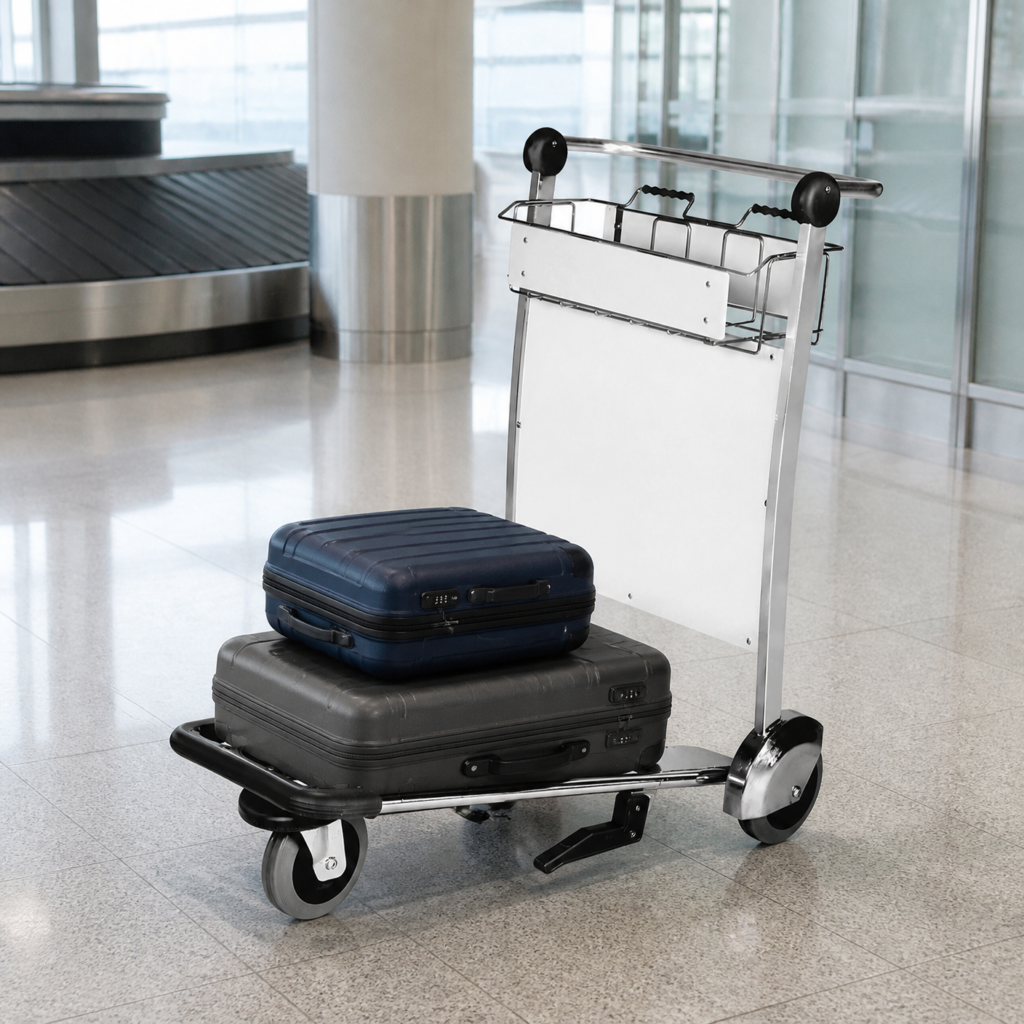
3. Evaluate Wheel Configuration on the Intended Route
A three-wheel model and a four-wheel model should be assessed as complete trolley designs. Wheel count alone does not establish maneuverability, stability or suitability for your terminal. Frame geometry, the offered wheel arrangement, the load used during evaluation and the route itself all belong in the comparison.
The two MINGLE examples above both list 180 mm natural-rubber wheels, despite having different wheel configurations. This illustrates why a shared wheel diameter is not enough to treat two models as operationally equivalent. Ask for the detailed wheel specification and identify which components can be replaced individually.
Arrange a supervised sample evaluation using representative baggage and a route approved by the airport team. Follow the supplier’s instructions and remain within its documented operating limits. Include ordinary activities such as starting, stopping, turning and moving through a storage-bay entrance. Do not improvise slope, impact or overload testing without an agreed procedure.
Record observations in a consistent format:
- Did operators encounter difficulty at particular turns or transitions?
- Was wheel behavior acceptable on the surfaces included in the trial?
- Could staff return and position the trolley using the proposed collection procedure?
- Were there concerns requiring a different wheel option or further clarification?
If braking or controlled-slope use is a project requirement, ask the supplier to document the offered system and its limits. Neither a photograph nor a model name establishes those capabilities. Carry unresolved questions into the technical review rather than treating them as accepted features.
4. Specify Baskets, Handles and Advertising Panels Separately
A trolley can meet the broad material requirement while still missing practical details needed by the terminal. Treat the basket, handle and advertising surfaces as separate specification items. This makes it easier to compare quotations and prevents a supplier from assuming that a standard component will automatically meet the project’s needs.
The CY-X4200-LG5 page lists an ergonomic flat handle, a fish-shape connector and alternative basket materials. These descriptions help identify the offered design, but they should not replace a hands-on review. Ask users and collection staff to evaluate access, grip and handling during the sample assessment.
For the basket, request dimensions and the supplier’s intended-use guidance. Check the proposed design against the small items passengers are expected to carry, and ask how the basket is attached, cleaned and replaced. Do not assume the basket and frame use the same material: the linked product pages explicitly list basket alternatives.
The CY-X4200-BG3 page lists two main advertising panels and advertising positions at the front and rear of the basket. If these will carry airport branding or commercial artwork, obtain a drawing showing the usable area and fixing method before artwork is produced.
Put the approval sequence in writing: component selection, dimensions, artwork proof, sample review and final approval. Ask whether branding changes affect price, timing or minimum order requirements; do not assume customization is included. A confirmed artwork proof and component schedule reduce ambiguity more effectively than a general request for a “branded airport trolley.”
5. Compare Quotations with an Acceptance and Maintenance Checklist
A useful quotation comparison separates documented facts from open questions. A supplier that lists an attractive model but leaves essential configuration details unresolved is not yet offering a like-for-like alternative. Keep those gaps visible instead of assigning the same assumptions to every bid.
Use the checklist below as a procurement worksheet, not as a statement that any supplier has already met the requirements.
| Decision area | Evidence to request | Acceptance question |
|---|---|---|
| Frame and basket | Model-specific material and finish descriptions | Does the offered configuration match the approved specification? |
| Wheels | Wheel arrangement, material, dimensions and part references | Does the sample meet the agreed route-evaluation criteria? |
| Dimensions and storage | Overall dimensions and nesting information | Does the arrangement fit the planned trolley bays? |
| Loading and operation | Written ratings, instructions and restrictions | Are the proposed uses within documented limits? |
| Branding | Panel drawings and approved artwork proof | Are the location, dimensions and fixing details correct? |
| Maintenance | Parts list, inspection guidance and warranty terms | Can the airport support the proposed fleet? |
Discuss maintenance with the supplier before price negotiation is complete. Request references for replacement wheels and other service components, together with ordering arrangements and any relevant maintenance instructions. Ask what the warranty covers, what it excludes and how a claim is assessed.
Keep purchase cost, spare parts, customization, freight and other quoted charges separate in your comparison. If you build a lifecycle-cost worksheet, label assumptions about usage and replacements; do not present an estimated saving as a measured outcome.
Finally, define the acceptance process. Specify what will be checked on the sample and what will be checked on the delivered order, with responsibilities agreed in advance. Do not imply independent certification or compliance unless the applicable documentation has been reviewed.
6. Prepare an OEM/ODM Enquiry That Suppliers Can Answer
MINGLE’s airport trolley product presents BG, LG and Shopper series and invites wholesale and OEM/ODM enquiries. A productive enquiry should connect the products you are considering to a clear terminal brief. Sending only a photograph and asking for a best price leaves too much of the configuration undefined.
Provide your required quantity, delivery destination, project timing and intended use. If quantity or timing is provisional, say so. Include the model references under consideration and explain which attributes are mandatory, which are preferred and which can be proposed by the supplier.
A practical request for quotation should ask for:
- A recommended model and a written explanation of its fit with the operating brief.
- A complete specification identifying frame, basket, wheels, dimensions and available options.
- Confirmed loading and operating limits, together with relevant instructions.
- Branding drawings, artwork requirements and the sample-approval procedure.
- Itemized pricing and clear delivery, packaging and payment terms.
- Sample arrangements, production timing, warranty coverage and replacement-part support.
Require exceptions to be stated explicitly. If a requested option is unavailable, the supplier should identify the proposed alternative and explain any effect on the quotation. Keep a record of revisions so that the order refers to the approved configuration rather than an earlier discussion.
For a MINGLE quotation, use the enquiry form on the MINGLE Airport Trolleys website. Share your terminal brief and request a model-specific proposal before approving an order. This is the next step toward a defensible purchasing decision—not a substitute for technical review and sample acceptance.
7. Frequently Asked Questions About Airport Luggage Trolley Procurement
The questions below summarize how to turn product listings into a purchasing decision. They are evaluation guidance rather than additional specifications for the featured models. Where the answer depends on a configuration or commercial commitment, obtain written confirmation for the actual order.
Should an airport choose aluminum or stainless-steel trolleys?
Neither material should be selected in isolation. Compare the offered models against the route, handling, maintenance and storage brief. The linked MINGLE examples use 6063 aluminum alloy and stainless steel 304 respectively, but those descriptions alone do not establish which complete trolley is the better fit for your project.
Are three-wheel airport luggage trolleys better than four-wheel models?
Do not decide from wheel count alone. Evaluate the complete design with representative baggage, an agreed route and the supplier’s operating instructions. Ask for the wheel arrangement and component details, and record any concerns during the sample review rather than assuming one configuration performs better everywhere.
Can the basket material differ from the frame material?
Yes, the linked MINGLE product pages list powder-coated steel and stainless-steel basket options. Confirm which basket is included in the quotation, its dimensions and any price difference. Make the selected option part of the approved order specification rather than relying on a photograph.
What should a buyer confirm before placing an order?
Confirm the model and configuration, documented operating limits, dimensions, branding proof, price, delivery terms, warranty and parts support. Resolve sample-review findings and any supplier exceptions. The final order should reference the approved specification so that purchasing, operations and the supplier are working from the same requirements.
Website: https://airport-trolley.com/products-series/
Email: sales02@gdmingle.com
WhatsApp: +86 133 9224 9161